

OpenClaw vs NanoClaw vs Hermes Agent: Which One Should You Run?
If you’re comparing personal AI agents in 2026, these are the three most interesting open-source options right now: OpenClaw, NanoClaw, and Nous Research’s Hermes Agent. They overlap just enough to create confusion. All three can act across chat interfaces, tools, and real systems. But they are not optimized for the same thing, which means the “best” one depends entirely on what you want the agent to optimize for.

Quick Verdict
- Choose OpenClaw if you want the richest “AI operator on my computer” experience with the biggest integration surface.
- Choose NanoClaw if you care most about isolation, auditability, explicit mounts, and keeping the blast radius small.
- Choose Hermes Agent if the key requirement is persistent memory, reusable skills, and an agent that improves at your workflows over time.
If the work touches sensitive data, I would start with NanoClaw or a tightly sandboxed Hermes setup, not a broadly permissioned OpenClaw deployment.
OpenClaw: Best for Maximum Capability
OpenClaw is the most obvious choice if your goal is breadth. It is the fullest expression of the “personal AI operator” idea: one assistant that can move across messaging apps, browser sessions, files, shell, SaaS tools, and plugins with minimal friction. If you want your agent to feel like a digital chief of staff that can do a little bit of everything, OpenClaw is the strongest fit.
That breadth is both the product and the risk. OpenClaw gives you the broadest ecosystem, the most complete feeling of agency, and the highest upside if what you want is convenience and power. It also gives you the largest operational and security surface of the three. The more permissioned the agent is, the more dangerous a bad extension, bad prompt injection, or bad deployment posture becomes.
Best for: people who want the richest overall experience and are willing to manage the operational risk.
NanoClaw: Best for Security-Conscious Self-Hosters
NanoClaw is the cleanest answer for people who hear “personal AI agent” and immediately ask what the blast radius is. Smaller codebase. Single host process. Per-agent-group containers. Explicit mounts. Credential routing that keeps raw API keys out of the agent. It is not trying to be the biggest framework. It is trying to be small enough to understand and contained enough to trust.
That makes NanoClaw the easiest recommendation for self-hosters handling sensitive data or anyone who wants to audit the whole stack without spelunking a giant codebase. The tradeoff is straightforward: it is leaner and more auditable than OpenClaw, but less batteries-included and less ecosystem-heavy.
Best for: people who want the safest starting point and the clearest mental model.
Hermes Agent: Best for Long-Running Workflows
Hermes Agent is the most interesting if your real requirement is not just “do this task” but “get better at this workflow over time.” Persistent memory, auto-generated skills, scheduled automations, isolated subagents, and multiple sandbox backends all point in the same direction: Hermes is built around compounding.
That matters most when the work repeats. Research loops. Ops routines. Reporting. Recurring investigations. Any workflow where remembering yesterday’s solution is half the value. Hermes is the best fit when you want a durable digital employee, not just a capable digital assistant.
The tradeoff is complexity. More memory means more state. More autonomy means more to bound. More learning means more runtime and token overhead. Hermes is not the leanest or simplest option. It is the one with the strongest long-term upside if your workflows repeat enough to justify the machinery.
Best for: long-running workflows where accumulated memory and reusable skills matter more than minimalism.
What Actually Matters
Most people start this comparison with features. I would start with operating model.
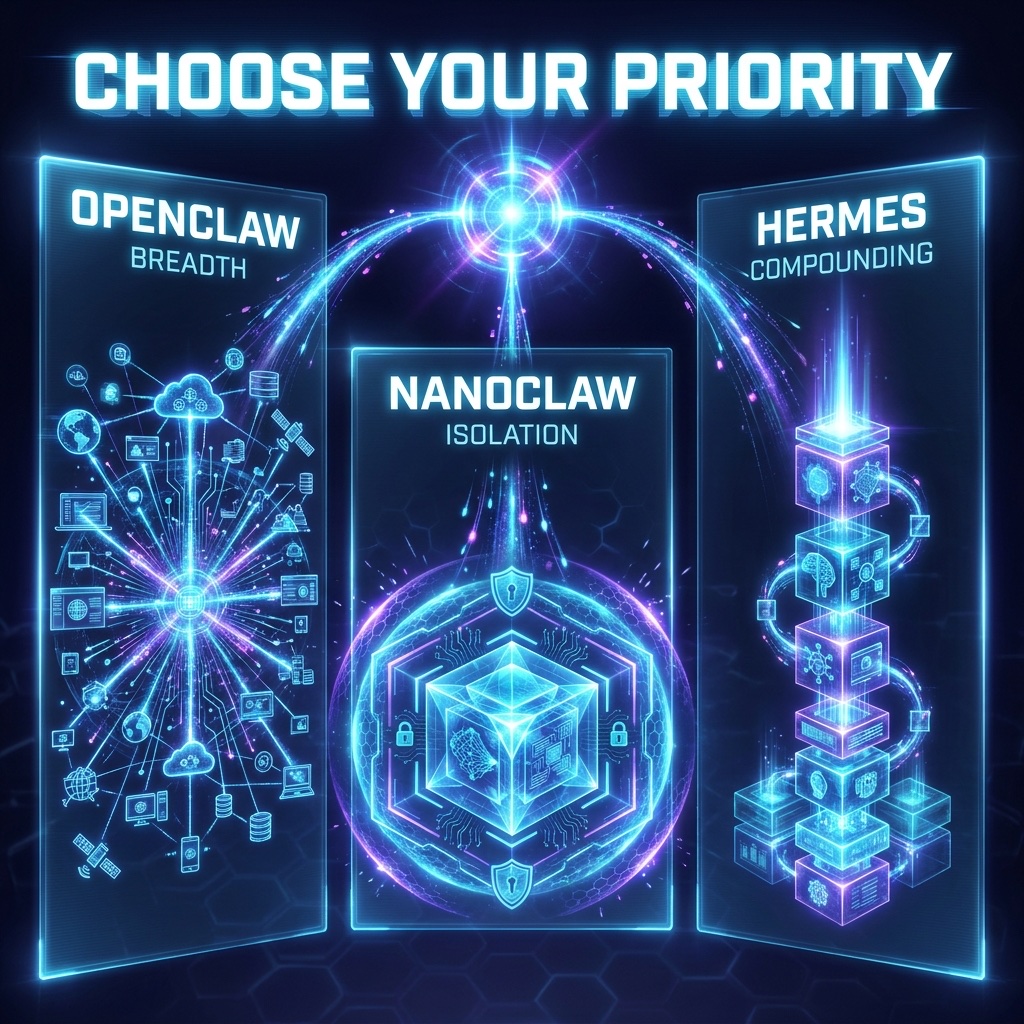
Once an agent can read messages, browse the web, run commands, and touch files or APIs, this stops being a toy comparison. It becomes a trust and architecture decision. This is the personal-agent version of Useful, Autonomous, Safe — Pick Two. The practical question is not “which one is best?” The practical question is what are you optimizing for: breadth, isolation, or compounding?
OpenClaw optimizes breadth. NanoClaw optimizes isolation. Hermes optimizes compounding. Once that frame clicks, the comparison gets much easier.
My Recommendation
If I wanted the richest operator experience, I would choose OpenClaw.
If I wanted a personal agent anywhere near sensitive data and I cared about understanding the whole stack, I would choose NanoClaw.
If I wanted an agent that gets better at repeated workflows over time, I would choose Hermes.
That is the real roundup. OpenClaw for reach. NanoClaw for trust. Hermes for learning. Choose the thing you can safely let into your life.