


Not Every Agent Needs AI
Everyone says they’re building “AI agents.” What they’re actually building ranges from a bash script with a friendly name to a multi-model autonomous system that costs $200/day to run. The industry has collapsed an enormous spectrum into one buzzword. Teams routinely overbuild simple automations and underbuild complex ones — because they never stopped to ask what kind of agent they actually need. There’s a clean taxonomy here. Two dimensions. Four levels. Eight distinct types. Name yours before you write a single line of code.

Two Dimensions Define Every Agent
Every automated system sits somewhere on two axes.
Trigger Mode: Reactive vs. Proactive
Reactive agents respond. Something happens — a user asks, a webhook fires, a schedule triggers — and the agent runs. It does its thing and goes back to sleep.
Proactive agents hunt. They run on a schedule too, but the key distinction is ownership. A proactive agent finds its own work. It scans, evaluates, decides, and acts — without being asked.
Most agents today are reactive. A human types a prompt. The agent responds. That’s fine for many use cases. But the highest-leverage agents are proactive — they work while you sleep.
Intelligence Level: 0 Through 3
This is the axis most teams get wrong. There are four levels of intelligence an agent can have, and each one has radically different cost, complexity, and reliability characteristics.
Level 0 — Classic. Zero AI. A fixed algorithm. Deterministic input, deterministic output. Fast, cheap, reliable, debuggable.
Level 1 — Explainer. A deterministic algorithm does the core work. AI layers on explanation, analysis, or insight at the end. The algorithm is the engine; the AI is the narrator. Reliability of Level 0 with the communication quality of AI.
Level 2 — Info Agent. AI shapes the information workflow and the output. The agent decides what to look at, how to structure findings, and what to surface. It doesn’t perform external work — it researches, synthesizes, and reports.
Level 3 — Worker Agent. AI shapes the workflow, performs the work, and explains what it did. Autonomous reasoning, autonomous execution, autonomous reporting. Maximum capability. Maximum cost. Maximum risk.
The Agent Matrix
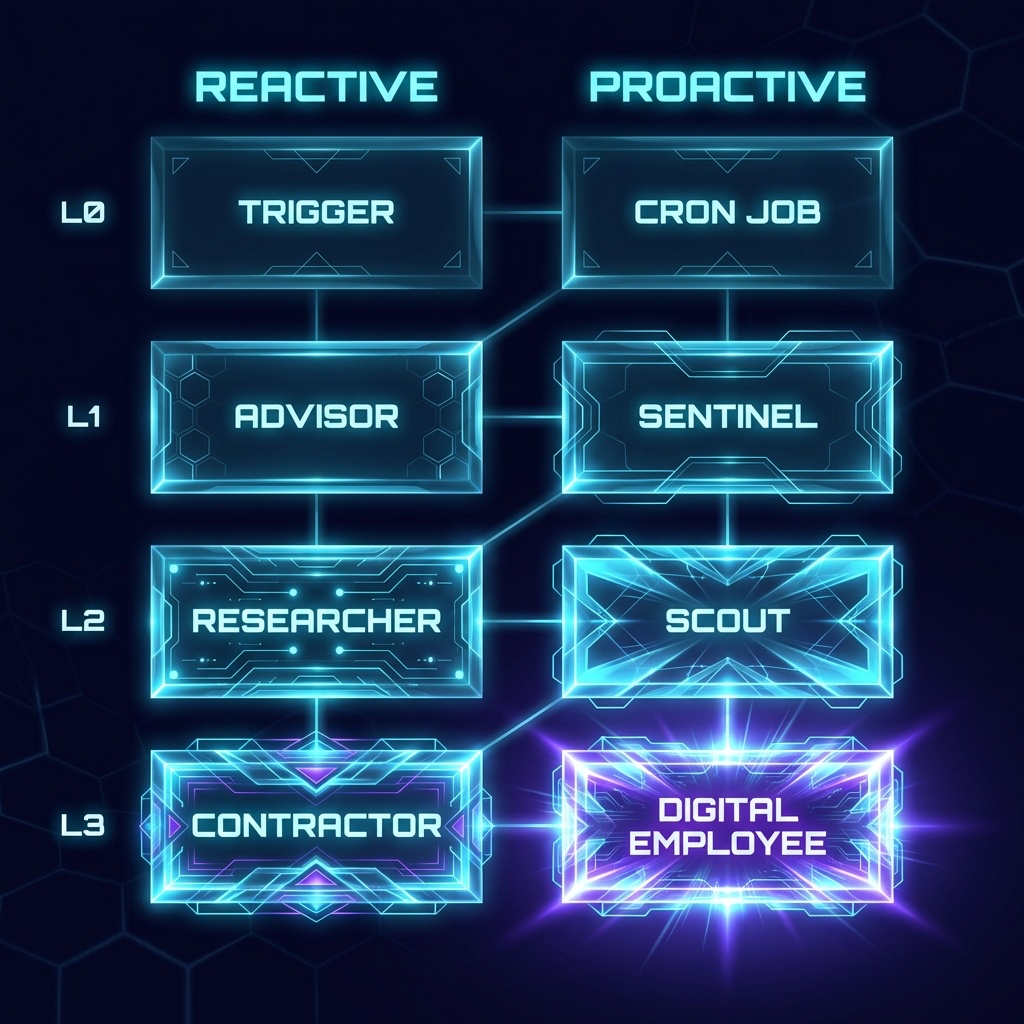
Cross the two dimensions and you get eight distinct agent types. Each has a name, a role, and a natural habitat.
| Reactive | Proactive | |
|---|---|---|
| L0 — Classic | Trigger | Cron Job |
| L1 — Explainer | Advisor | Sentinel |
| L2 — Info Agent | Researcher | Scout |
| L3 — Worker | Contractor | Digital Employee |
Triggers and Cron Jobs (L0)
Trigger: A user clicks a button or an event fires. A fixed algorithm runs. No AI involved. A Slack command that queries a database and returns formatted results. Fast, cheap, bulletproof.
Cron Job: Same fixed algorithm, but it runs on a schedule. A nightly script that reconciles inventory counts. The original “agent” — and still the right answer for most operational tasks.
Advisors and Sentinels (L1)
Advisor: A user asks a question. A deterministic process gathers the data. AI explains the result in plain language. A sales dashboard that runs SQL queries and then uses an LLM to generate a natural-language summary of the trends. The algorithm does the math. The AI tells the story.
Sentinel: A scheduled process monitors for conditions. When something triggers, AI explains what happened and why it matters. A monitoring system that checks error rates every hour and generates a human-readable alert with context and suggested next steps. The sentinel doesn’t just page you — it tells you what’s wrong.
Researchers and Scouts (L2)
Researcher: A user asks a complex question. AI decides what data sources to query, how to structure the research, and what to include in the output. “What are our competitors doing with pricing this quarter?” The agent searches, filters, synthesizes, and delivers a brief. It doesn’t just retrieve — it curates.
Scout: Same as the Researcher, but proactive. It runs continuously, scanning for signals without being asked. An agent that monitors patent filings, news, and social media for competitive intelligence, surfacing a weekly digest of what matters. The scout is already looking before you think to ask.
Contractors and Digital Employees (L3)
Contractor: A user assigns a task. AI plans the approach, executes the work, and reports back. “Refactor the authentication module to use JWT.” The agent reads the code, plans the migration, writes the code, runs tests, and submits a PR with a summary. Full autonomous execution, on demand.
Digital Employee: The apex. A proactive L3 agent finds its own work, plans it, executes it, and reports what it did. An agent that monitors the backlog, picks the highest-priority bug, investigates root cause, implements a fix, and opens a PR — all before standup. This is the category everyone talks about. Almost no one has built one that works reliably.
The Mistake Everyone Makes
Teams jump to Level 3. They want the Digital Employee. They want the full autonomous agent that reads their mind and ships code while they sleep.
The result: expensive, unreliable, hard-to-debug systems that produce inconsistent results and require constant babysitting — which defeats the entire purpose.
Meanwhile, a Level 1 Sentinel could have solved 80% of their monitoring problem at 5% of the cost. A Level 0 Cron Job could have handled their nightly reconciliation perfectly. A Level 2 Researcher could have replaced their manual competitive analysis without needing to do anything — just synthesize.
The right agent is the simplest agent that solves the problem.
Level 0 agents are fast, cheap, and reliable. Level 3 agents are powerful, expensive, and fragile. Everything in between has a role. The matrix isn’t a ladder to climb — it’s a map to navigate.
Name It, Then Build It
Before you write a single line of agent code, answer two questions:
- Does this agent react to triggers, or find its own work?
- What intelligence level does the job actually require?
Plot it on the matrix. Name the type. Then build exactly that — no more, no less.
A Trigger doesn’t need GPT-4. A Sentinel doesn’t need autonomous execution. A Scout doesn’t need write access to production.
Build the agent the job demands. Not the agent your ambition imagines.