

Dark Factory: Man & Machine
2026 is the age of the software factory. Dark factories where agents run the line at 3am with no humans in the building. Light factories where humans and agents work side by side at the bench. Every ambitious company is racing to build one — and most of them are buying the same fantasy: that once the factory is built, the engineers go away. They won’t. The factory will eat the typist, but it will mint a new role nobody has staffed yet — the Operator.
The Fantasy and the Forklift
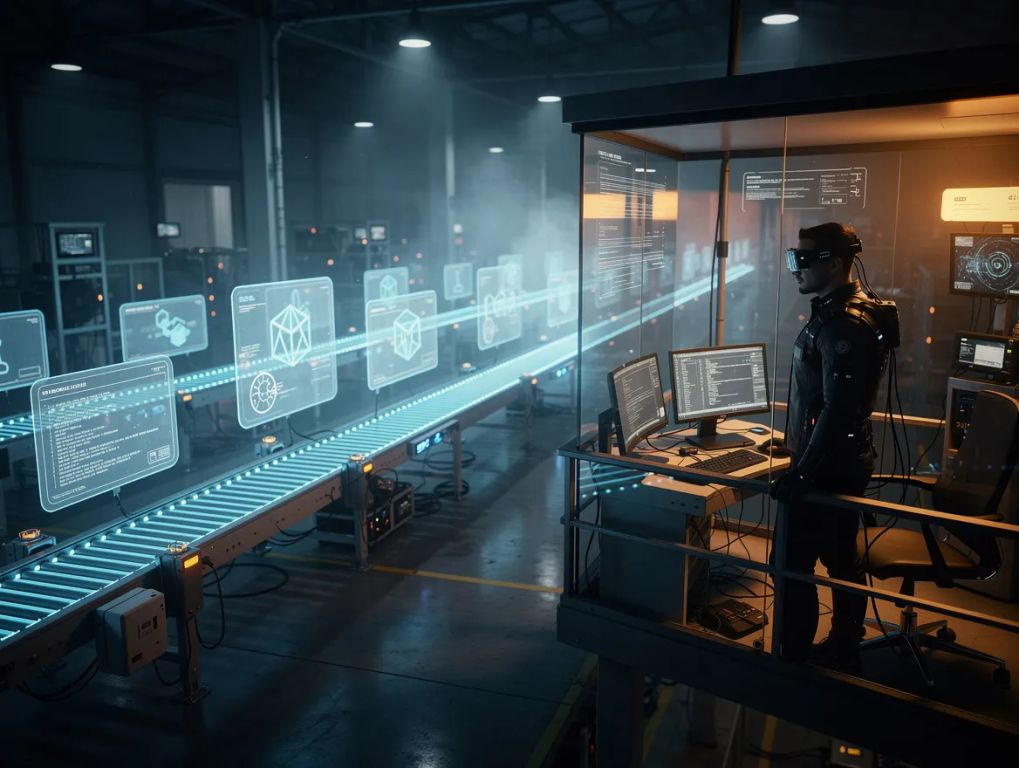
Every executive deck this year has the same picture. A serene control room. A blinking dashboard. A green check mark. Software building itself. No engineers, no PMs, no late-night Slack threads. Just output.
That’s not a factory. That’s a screensaver.
Real factories — the ones that actually produce things — never automated their humans away. CnC machining didn’t kill the machinist. It birthed five new jobs: the people who make the CnC machines, the people who sell them, the people who write the toolpath software, the people who integrate them into a line, and — most importantly — the people who operate them. The machinist didn’t disappear. They got promoted into a cyborg. One human, one console, ten machines.
Software factories will play out the same way. Anyone who thinks “build the factory and the engineers go away” has never stood next to a CnC mill at 2am while the spindle screams and the part is two thousandths off and someone has to decide what to do.
The New Roles the Factory Creates
The software factory is not one product. It’s a stack. And like every real industrial stack, each layer creates its own discipline:
- Factory Architects — engineers who design the pipeline itself. They pick the agents, the eval harnesses, the queues, the guardrails. They build the line.
- Factory Builders — the people writing the actual platform: the orchestrators, the tool registries, the sandboxing, the observability. They build the machines that build the software.
- Factory Sellers — yes, these will be everywhere. Templates, marketplaces, reference factories, vertical kits. The “Shopify for software factories” companies are already pitching.
- Factory Pipeline Engineers — the equivalent of CAM programmers. They write the specs, the prompts, the toolpaths the agents follow.
- Factory Operators — the humans who run the line, every day, on every job.
Every layer matters. But only one layer gets stronger as the factory gets better. The Operator.
What Operators Actually Do
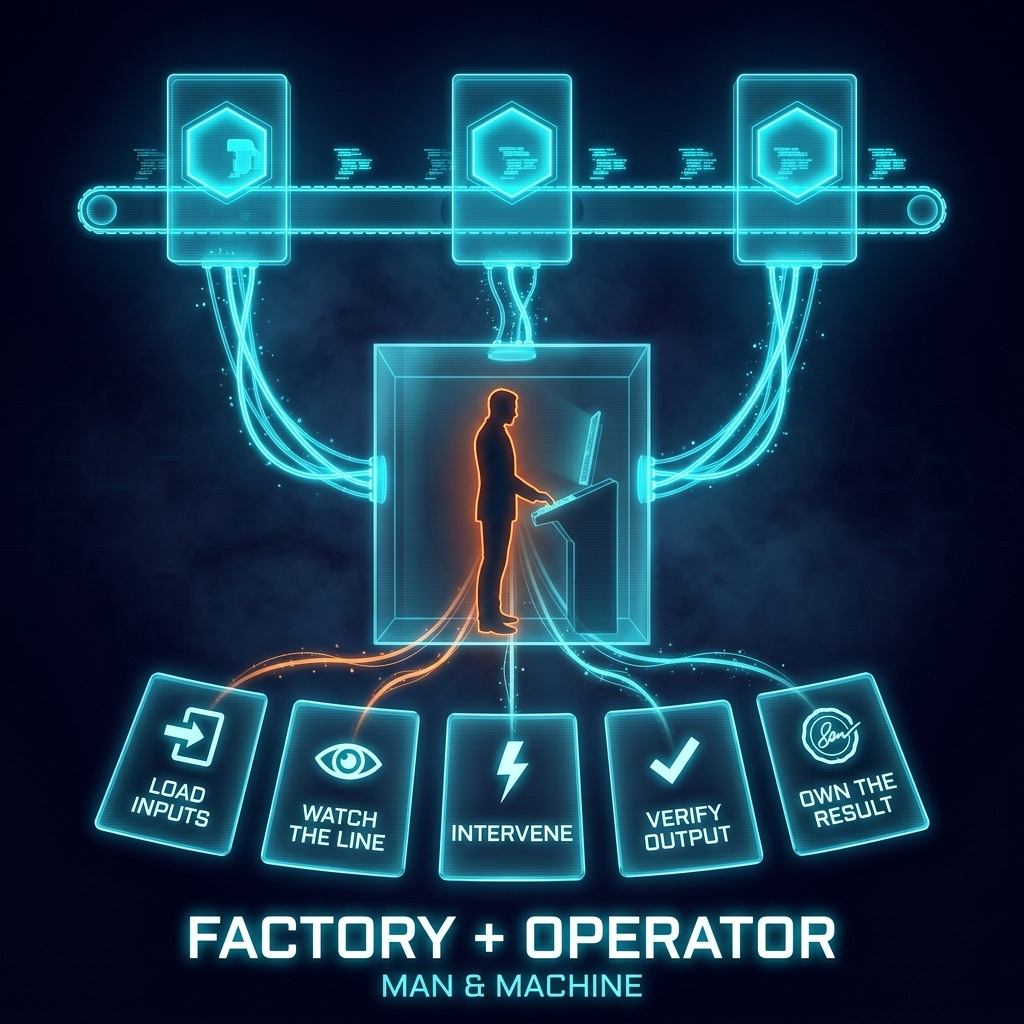
The Operator is not “a person who supervises the AI.” That framing is lazy and wrong. The Operator is the only role in the entire factory that does five things no agent can do reliably:
- Load the inputs correctly. Specs, constraints, references, examples, the customer’s actual ask. Garbage in is still garbage out, even at 1,000 tokens per second.
- Watch the line. Not stare at logs — read the line. Detect drift. Smell wrongness. Notice the part that’s coming out subtly off.
- Intervene on errors. Step in when the agent loops, hallucinates, picks the wrong tool, or starts producing something nobody asked for. Resume the line in a clean state.
- Verify the output. Run it. Use it. Stress it. Decide whether it ships. The factory does not get to declare its own work done.
- Take ownership. Sign their name to the result. Carry the on-call pager. Eat the consequences when it breaks.
No current agent — including the best ones — does all five. They do the typing. The Operator does the judgment. The factory is the muscle. The Operator is the nervous system.
The Cyborg Technician
The Operator role is not a downgrade from “engineer.” It’s a different alloy. Half engineer, half pilot, half product manager — fused with the factory through tools, dashboards, and trained reflexes. A Cyborg Technician.
A good Operator in 2026 has:
- A spec mindset: can compress fuzzy intent into a tight, executable brief.
- A line sense: can tell from logs, traces, and partial output whether the run is healthy.
- A toolbelt: tail commands, replay tools, eval suites, manual override switches.
- An ownership posture: the run’s output is theirs, even though they didn’t type it.
This isn’t future-tense. The best engineers I work with already operate this way. They’re not coding more — they’re running more lines, supervising more agents, shipping more units of work per week than any 10x engineer ever did. They’ve already become Cyborg Technicians; they just don’t have a business card for it yet.
The Lights Go Out, the Console Stays Lit
The dark factory dream is real. Most of the typing will be automated. Most of the boilerplate will be generated. Most of the routine will be on rails.
But the lights never fully go out. Somewhere in every dark factory, one console stays lit, one Operator stays on the line, and one human takes the call when the machine builds the wrong thing perfectly.
You don’t automate the Operator. You arm them.
If you’re building a software factory, hire architects, hire builders, buy tools — but staff the Operators first. They are the only role that scales the factory’s value instead of its risk. And if you’re an engineer wondering what your job looks like in five years, stop training to be replaced by the factory. Train to run it.
The age of the software factory needs the man and the machine. Build both.