


You Just Spent 45 Minutes Doing Your AI's Job
You know the feeling. Your AI agent asks a question it should already know the answer to. So you open your database, run a query, copy the results, paste them into the chat, explain the schema, correct its misunderstanding, re-run it. Forty-five minutes gone. You were supposed to be making decisions today. Instead, you were a human API — copying data between systems because your AI couldn’t reach the shelf. This is the most expensive mistake in AI adoption right now, and almost everyone is making it.

The Scene You Recognize
It starts innocently. You ask your AI to analyze last quarter’s churn. It says, “I don’t have access to your customer data. Can you share the relevant records?”
So you open pgAdmin. Write a query. Export to CSV. Upload the file. The AI reads it, misinterprets a column name, asks a follow-up. You explain. It tries again, gets closer. You correct a date range. It regenerates. Twenty minutes in, you realize you’ve been doing the analysis yourself — using the AI as a fancy text formatter.
Sound familiar?
You’re not alone. This is the default experience for 90% of people trying to use AI at work. The AI is capable. You just haven’t given it the job.
This Isn’t an AI Problem
Here’s the emotional turn most people aren’t ready for:
This is a you problem.
You hired the smartest intern on earth. Ph.D. in everything. Photographic memory. Works 24/7 without complaining. And then you locked them in a windowless room with no computer, no phone, no access to any of your systems.
Of course they keep asking you questions. Of course they get things wrong. Of course you spend your day running back and forth between the room and your office, carrying printouts like it’s 1997.
You didn’t give them what they need.
The intern isn’t broken. The onboarding is broken.
Every time you paste data into a chat window, you’re doing work your AI should be doing. Every time you explain your schema, you’re compensating for missing context. Every time you run a query on behalf of your agent, you are the API.
You are the slowest, most expensive, least reliable integration in your entire stack.
Why You Keep Doing It
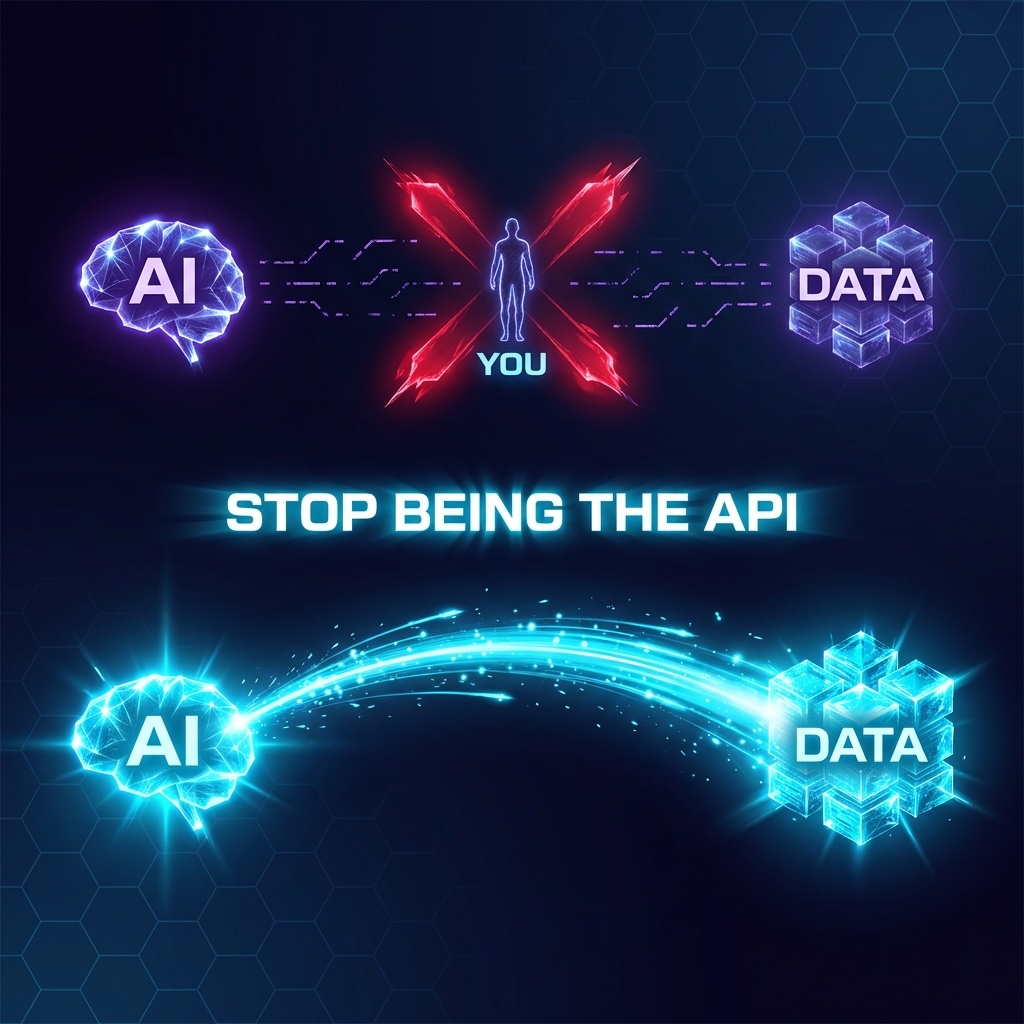
The trap is psychological. You can do it faster. Right now. Today. You know the query. You know the schema. You can have the answer in 3 minutes.
Setting up database access for your agent? That might take an hour. Maybe two. There’s auth to configure. Connection strings. Maybe an MCP server to set up. Maybe a read-only replica to provision.
So you take the 3-minute shortcut. Again. And again. And again.
Three minutes, forty times a week, is two hours. Two hours of being a human API. Two hours you could have eliminated permanently with a single afternoon of setup.
This is the calculus that kills AI adoption: people optimize for today’s convenience instead of tomorrow’s capability. They choose 3 minutes of manual work over 2 hours of permanent automation because the manual work feels productive. It isn’t. It’s maintenance disguised as contribution.
The Human API Trap
Here’s what the human API pattern actually costs you:
Speed. You are slower than a database connection. You always will be. Your agent waiting for you to copy-paste is like a Formula 1 car waiting for someone to hand-crank the engine.
Accuracy. You make mistakes. You grab the wrong date range. You forget a filter. You misformat a CSV. Your agent, connected directly, doesn’t make these errors.
Availability. You sleep. You eat. You take meetings. Your agent with direct access works at 3 AM on a Sunday without asking you to export anything.
Scale. There’s one of you. There could be fifty agents. But they all bottleneck on the same human API — you, hunched over pgAdmin, running queries like a help desk for robots.
You are not a data layer. Stop acting like one.
Connect One Source This Week
Here’s your way out. Not the whole transformation. Not a six-month roadmap. One data source. This week.
Pick the system your AI asks about most. The one that triggers the most copy-paste sessions. For most people, it’s one of these:
- Your database. Set up a read-only connection. Give the agent direct query access.
- Your docs. Connect your knowledge base, wiki, or Google Drive so the agent can search it.
- Your project tracker. Let the agent read Jira, Linear, or GitHub Issues directly.
- Your CRM. Give the agent access to customer records without you as the middleman.
Pick one. Just one. Connect it.
The first time your agent answers a question by querying your database directly — without asking you to export anything — you’ll feel the shift. That forty-five minutes collapses to forty-five seconds. Not because the AI got smarter. Because you stopped standing between it and the data.
The Compounding Unlock
One connection changes your relationship with your AI. Two connections change your workflow. Five connections change your job description.
Every data source you connect is a permanent upgrade. It doesn’t decay. It doesn’t need to be re-done. Your agent can use it at 3 AM, across a hundred tasks, for the rest of its operational life.
The people who are getting real value from AI right now aren’t the ones with the best prompts. They’re the ones who have eliminated themselves as the bottleneck. They’ve connected their systems. They’ve given their agents the access that transforms a chatbot into a collaborator.
Your AI doesn’t need better prompts. It needs fewer middlemen.
Stop Being the API
You spent 45 minutes doing your AI’s job yesterday. You’ll do it again today unless something changes.
The change isn’t a new model. It isn’t a better prompt. It isn’t a different tool.
The change is a connection string. A read-only credential. An MCP server. A bridge between your agent and the data it needs.
Build one bridge this week. Just one. Watch what happens when your smartest intern finally gets a computer.
You just spent 45 minutes doing your AI’s job. Make it the last time.