


Useful, Autonomous, Safe — Pick Two
Every team building AI agents hits the same wall. You want the agent to be useful — capable of real work with real tools. You want it autonomous — running without a human babysitting every action. And you want it safe — resistant to manipulation, predictable in behavior. The AI Assistant Trilemma says you only get two. Until prompt injection is fundamentally solved, this constraint is as hard as the CAP theorem — and just as non-negotiable.

The Constraint Nobody Wants to Admit
Most AI agent discourse falls into two camps: breathless acceleration (“give agents full access to everything!”) or anxious paralysis (“agents are too dangerous to deploy!”). Both miss the actual engineering problem.
The trilemma isn’t opinion. It’s structural.
For an AI agent to be useful, it needs access to real systems — email, APIs, databases, file systems, the web. For it to be autonomous, it needs to act without waiting for human approval on every step. For it to be safe, it needs to resist adversarial manipulation from untrusted inputs.
The problem: every external data source is a potential attack vector. A malicious email, a poisoned web page, a crafted document — any of these can inject instructions that the agent follows as if they came from the user. This isn’t theoretical. In mid-2025, a zero-click prompt injection via email exfiltrated confidential data from Microsoft 365 Copilot without any user interaction. The agent was useful. It was autonomous. It was not safe.
Prompt injection is the unsolved problem at the center of the trilemma. Until a model can reliably distinguish “instructions from my user” from “instructions embedded in data I’m processing,” you cannot have all three vertices.
The Three Trade-Offs
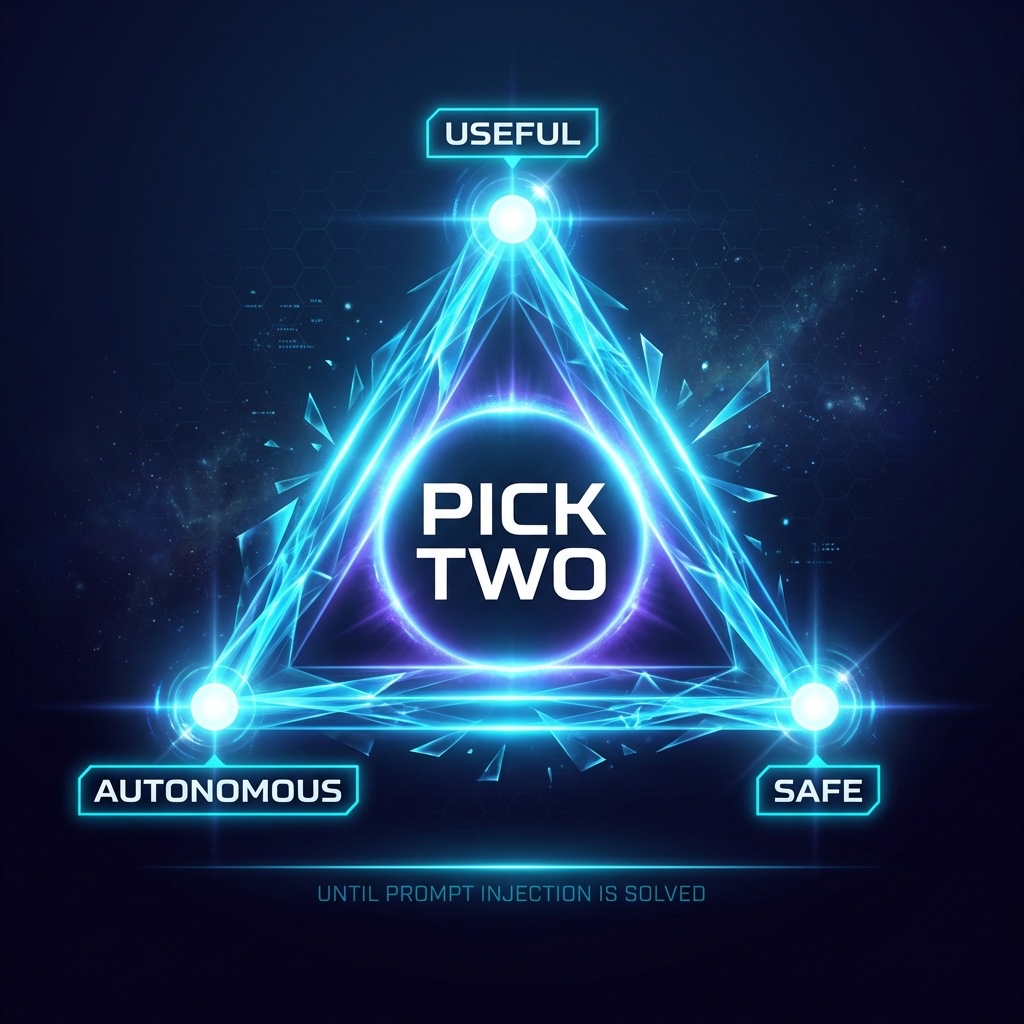
Every AI agent deployment picks a side of the triangle. Here’s what each sacrifice looks like in practice.
Useful + Autonomous (Sacrifice Safety)
The agent has full tool access and minimal human oversight. It reads emails, browses the web, executes code, calls APIs — all at machine speed. Extremely productive. Also extremely exposed. One poisoned input, and the agent is working for someone else. This is the “move fast and hope nothing goes wrong” configuration. Startups love it. Security teams hate it.
Useful + Safe (Sacrifice Autonomy)
The agent has powerful tools but runs on a leash. A human approves sensitive actions. The agent proposes; the human confirms. You get real work done, but velocity is capped by human attention. This is where most production systems sit today — and for good reason. It works. It’s just slow.
Autonomous + Safe (Sacrifice Usefulness)
The agent operates independently within an airtight sandbox. No external data. No real tool access. No ability to affect real systems. It’s safe because it’s inert. Technically autonomous, practically a toy. A chatbot-in-a-box that can’t actually do anything for you.
The Practitioner’s Move
The trilemma is real, but it’s not static. The winning strategy isn’t to accept a permanent sacrifice — it’s to start at Useful + Safe, then systematically expand the safe perimeter.
This is architectural work, not model work. You engineer the boundaries that let autonomy grow without safety shrinking:
- Scoped permissions — The agent can deploy to staging, not production. It can read metrics, not delete databases.
- Reversible actions — Git commits revert. Feature flags toggle. Deployments roll back.
- Observable execution — Every action logged. Every change auditable. Full iteration history available for review.
- Bounded domains — Close loops within safe perimeters. An agent optimizing query performance doesn’t need access to billing.
Each boundary you prove safe is a boundary you can expand. Each loop you close within that boundary is autonomy gained without safety lost. This is exactly what closing the loop looks like in practice — you’re not removing guardrails, you’re making the track wider.
Safety comes from architecture, not supervision. The teams that ship fastest aren’t the ones that skip the trilemma. They’re the ones that engineer around it — expanding the safe perimeter one bounded domain at a time.
Pick Two, Then Expand
The AI Assistant Trilemma is the defining constraint of the agentic era. Pretending it doesn’t exist gets your data exfiltrated. Refusing to build agents at all lets your competitors lap you.
The move: pick Useful + Safe. Sacrifice autonomy at first. Then earn it back — one closed loop, one bounded domain, one scoped permission at a time.
Useful, Autonomous, Safe — pick two. Then engineer your way toward all three.