


Conscript, Cyborg, Centaur, Centurion
Most discussion of AI at work pretends there are two camps: people who use it and people who don’t. There aren’t. There are four. Conscripts at the bottom, Cyborgs and Centaurs in the middle, Centurions at the top. By the end of this decade, your career trajectory will be set less by your title and more by which of those four you actually are.
A Two-Camp Story Doesn’t Survive Contact With 2025
The shorthand “AI users vs non-AI users” is too coarse to plan a career around. It collapses lifestyles, incomes, and futures that have nothing in common. Pick the wrong tier and you don’t lose 10%; you lose an order of magnitude in output per hour. The bottom tier gets conscripted into pace-of-machine work for someone else’s margin. The top tier owns the machine. Same labor market. Different orbits.
The cleanest naming we already have comes from Ethan Mollick’s Centaurs and Cyborgs on the Jagged Frontier, based on a 758-consultant BCG study. Centaur work keeps a strategic division of labor between human and AI. Cyborg work blends human and AI into one intertwined flow. Both beat working without AI. Both are real careers. But that taxonomy stops at two — and the world has already grown a tier below and a tier above.
The Four Classes
1. Conscripts — No AI
Conscripts are knowledge workers who refuse, can’t afford, or aren’t allowed to use AI in their actual paid work. Some are blocked by employer policy. Some by ideology. Some never learned. The market does not grade on motive.
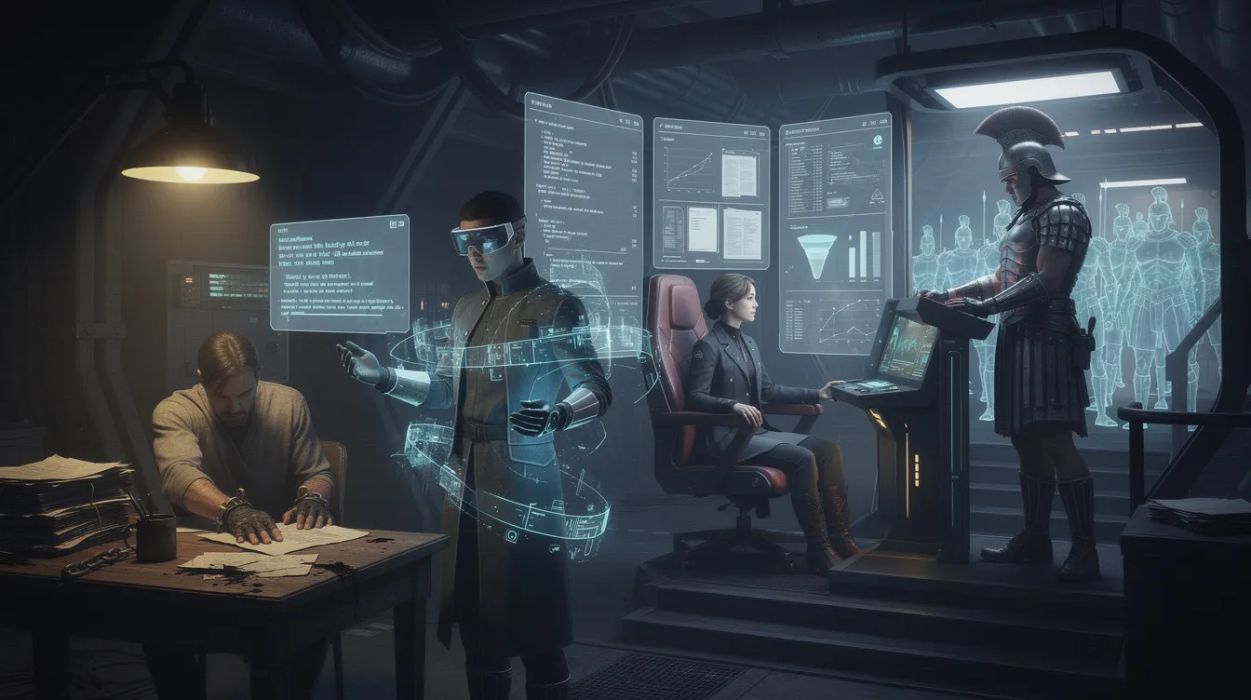
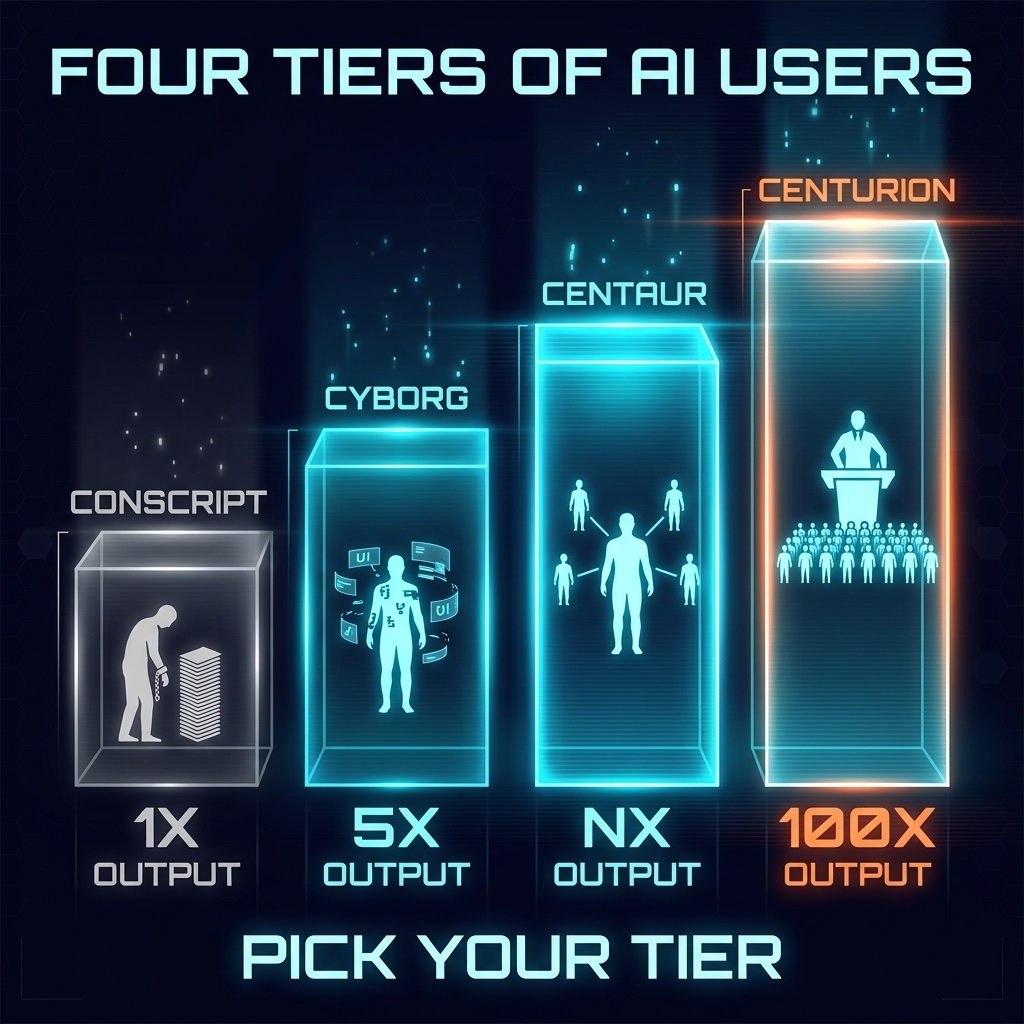
A Conscript still types every email by hand, still copy-pastes data between tabs, still writes the same boilerplate Monday after Monday. Their employer pays them like a typist because that is what they are. As AI productivity climbs roughly 20% a year on routine tasks, Conscripts get more tickets and less margin to live on. They are not outside the AI economy. They are inside it as cheap labor.
The economy uses Conscripts as ballast.
2. Cyborgs — AI Woven In
A Cyborg writes a sentence and lets the model finish the next two. They paste a screenshot and get a JSON schema back. They alternate human-AI-human inside the same paragraph, the same function, the same Slack reply. The work is one continuous flow with two intelligences moving through it.
The handoff cost is so low a Cyborg does not feel it. They live inside the tool. They have keyboard shortcuts for prompts that used to be sentences. They prompt mid-thought, mid-sentence, mid-meeting. Cyborgs are the fastest individual contributors of 2025.
A Cyborg’s day is the old day, three to five times denser.
3. Centaurs — Clear Division of Labor
A Centaur draws a clean line between what they do and what the AI does, and trusts the division. They write the spec; the agent ships the PR. They review the diff; the agent fixes the comments. They drive the strategy; the agent grinds the research. Handoffs are explicit. Boundaries hold.
Centaurs scale by delegation, not entanglement. Where a Cyborg blends, a Centaur dispatches. That makes a Centaur slower per task and dramatically more parallel. They can run three jobs at once because none of them are theirs to type. This is the model most senior engineers and PMs converged on through 2024 and into 2025. They stopped trying to type faster. They started delegating cleaner.
A Centaur’s day is N parallel days, each one done by a deputy.
4. Centurions — A Hundred Agents
Now the new tier — the one nobody had a name for yet. A Centurion commands a company of agents. A hundred. Two hundred. Five hundred. Running 24/7. Inbox. Codebase. Sales pipeline. Ops. Research. Recruiting. Customer success. They are not operating an agent. They are operating a force.
Centurions don’t type prompts the way a Cyborg does. They don’t hand tasks off the way a Centaur does. They configure a fleet: role definitions, eval harnesses, queues, escalation lanes, kill switches, budgets. The job is no longer talking to an AI. The job is running the org of AIs below them. Read a Centurion’s logs and it looks less like a chat thread and more like a small company’s operations dashboard.
You can already see them on X. One person. Hundreds of agent threads. Daily PRs across a dozen repos. A few thousand dollars a month in inference. The output of a 50-person team, none of whom show up on payroll.
A Centurion’s day is a hundred parallel days, done by a hundred deputies.
The Tier Is the Career
Movement through these tiers is not automatic and not chronological. Plenty of senior engineers are still Conscripts. Plenty of college kids are already Centaurs. The tier you land in is set by three questions, in order:
- Do you use AI in your real, daily, paid work? (Conscript vs not-Conscript)
- Have you built fluency, taste, and handoff discipline? (Cyborg vs Centaur)
- Have you built or borrowed the infrastructure to run a fleet? (Centaur vs Centurion)
You don’t drift into Centurion. It takes deliberate infrastructure: orchestration, evals, observability, guardrails, queues, budgets. And it takes a personal posture of owning the output of work you didn’t type. That last piece is an identity shift, not a tool purchase. Most engineers I see stall at Centaur not because of skill, but because they are unwilling to put their name on output the model produced unsupervised.
Pick Your Tier
By the end of this decade, the gap between a Conscript and a Centurion will be the gap between a peasant and a CEO. Same species. Same labor market. Different output per hour by two orders of magnitude. Income will follow output, as it always does.
You don’t get to pick your title. You get to pick your tier.
Conscript, Cyborg, Centaur, Centurion. Pick deliberately, before the market picks for you.