

Back-and-Forth Is the Bottleneck
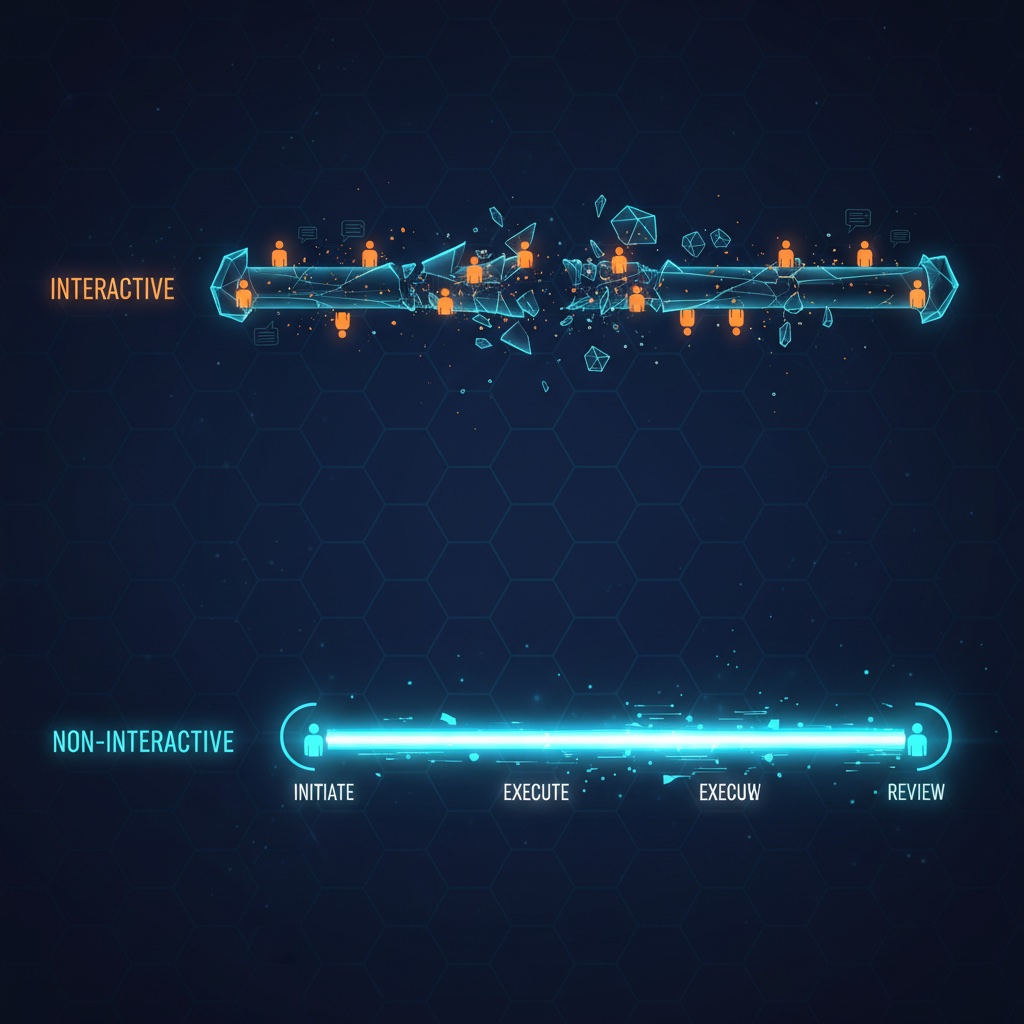
You open your AI agent. You describe the task. It asks a clarifying question. You answer. It starts working, gets stuck, asks another question. You answer. It produces a draft, you give feedback, it revises, you give more feedback. Ninety minutes later, the thing is done — and you were involved in every single step. You didn’t delegate a task. You had a meeting. The most expensive, lowest-throughput meeting of your day, and you hold it dozens of times a week.

Interactive Mode Feels Like Collaboration
It isn’t.
Every message you send is a context switch. Every clarifying question is a round trip through the slowest node in the system — you. Every “looks good, but change X” is a synchronous blocking call on a resource that sleeps eight hours a day and checks Slack during the other sixteen.
Interactive mode in Cursor, Claude, Codex — whatever your tool — puts you at the center of every operation. You’re not the architect. You’re the scheduler. And the scheduler is running on biological hardware from 200,000 years ago.
The human is always the bottleneck. Not because humans are dumb. Because humans are slow. An AI can iterate a hundred times in the time it takes you to read its first response. Every time it pauses to wait for you, that throughput drops to zero.
The Non-Interactive Pattern
The highest-throughput AI workflows share one structural property: the human touches the work exactly twice. Once at the beginning. Once at the end.
- Initiate — Describe what you want, completely, upfront.
- Autonomous execution — The agent works without interruption.
- Review — You evaluate the finished output.
No mid-stream questions. No incremental feedback. No “does this look right so far?” The agent has everything it needs from the start, or it has the tools to figure it out on its own.
This is the difference between a meeting and a work order. A meeting requires your presence for the duration. A work order requires your presence for thirty seconds at the front and thirty seconds at the back. The work happens without you.
Non-interactive is the only pattern that scales.
Why Interactive Mode Persists
It’s the default because it’s easy to start. You don’t need a plan. You don’t need to think through the full scope. You just start talking and let the conversation evolve.
This is exactly why it’s slow.
Every “let me clarify” from the AI is a failure of upfront specification. Every “should I do X or Y?” is a missing decision. Every “here’s a draft, what do you think?” is a premature checkpoint that resets the clock on your attention.
Interactive mode optimizes for low upfront effort. Non-interactive mode optimizes for throughput. These are not the same thing, and the gap between them is enormous.
Four Things That Kill Back-and-Forth
Getting to non-interactive isn’t magic. It’s engineering. Four inputs eliminate the need for mid-stream conversation:
1. Detailed Planning Upfront
Don’t describe the task in one sentence. Describe it completely. Include context, constraints, edge cases, examples. The more you front-load, the less the agent needs to ask.
A vague prompt creates a conversation. A precise specification creates an execution.
2. Unambiguous Definition of Done
If the agent doesn’t know what “done” looks like, it will either stop too early or ask you. Both are back-and-forth in disguise. Spell out the acceptance criteria. What files should exist? What tests should pass? What behavior should be observable?
A clear definition of done is a conversation-killer. That’s exactly what you want.
3. Evolved Rules and Non-Negotiables
Your codebase has standards. Your team has conventions. Your product has constraints. If these live in your head, the agent will violate them, and you’ll spend time correcting it. Put them in writing. Project rules, style guides, architectural decisions — codify everything the agent would otherwise need to ask about.
Every rule you write is a future question you’ll never have to answer.
4. Proof of Work and Summary
The agent should prove it did the work and make review effortless. Logs. Test results. Before/after diffs. A summary of what changed and why. You shouldn’t have to interrogate the agent to understand what happened. The output should be self-documenting.
Proof of Work replaces trust. You don’t need to watch the agent work if you can verify the result.
Software Factories Run on Silence
This is what unlocks high throughput.
Not better prompts. Not faster models. Not more chat windows. A system where humans initiate and review, and everything in between runs at machine speed.
Imagine ten tasks queued. Each one has a complete specification, clear acceptance criteria, codified rules, and a structured output format. You write the specs in the morning. The agents execute in parallel. You review the results in the afternoon. No meetings. No messages. No back-and-forth.
That’s a software factory. Not a metaphor. A literal production line where the human role is design and quality control, and execution runs autonomously.
The teams shipping at 10x aren’t prompting better. They’ve eliminated the conversation. They’ve replaced back-and-forth with front-loaded specification and back-loaded verification.
Initiate. Execute. Review. No back-and-forth.