
The 6,000-Year Era of Human Execution Just Ended
For thousands of years, the person with the idea also had to do the work. That era is over. AI can now execute at a level that makes human execution obsolete for most knowledge work. The companies that internalize this will operate at 10x the velocity of those still bolting AI onto human workflows. The question isn’t whether to make the shift—it’s whether you’ll lead it or be displaced by it.
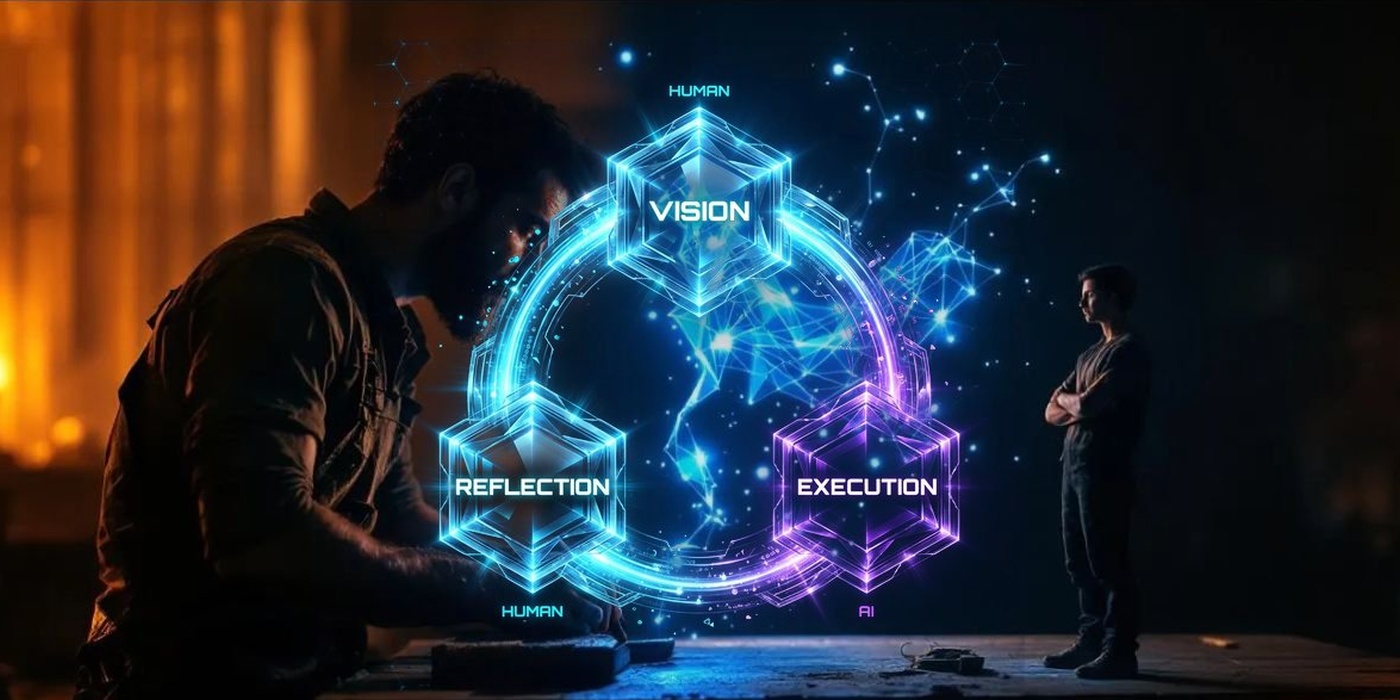
All productive work follows a loop: Vision → Execution → Reflection. Someone imagines a future state. Someone makes it real. Someone evaluates the result and imagines what’s next.
Originally, one person did all three. The craftsman envisioned the table, built the table, assessed the table.
Then humanity discovered delegation. The visionary could hand execution to others. This unlocked scale. It created companies, shared purpose, employment. It also created slavery. But the fundamental innovation was the same: separate the thinker from the doer.
Most “AI-powered” companies today bolt AI onto human workflows. AI assists. AI suggests. AI accelerates. Humans still execute.
That’s not AI-Native. That’s AI-Adjacent.
The AI-Native Question
Before doing anything, ask: Is this vision work, or execution work?
Vision work is deciding what should exist. Execution work is making it exist. Reflection work is evaluating what exists against what should exist.
In a purely AI-Native company, the split is absolute:
- Humans: 100% Vision. 100% Reflection.
- AI: 100% Execution.
Zero human execution. Not “less” human execution. Zero.
What This Looks Like
The old way: You have an idea for a feature. You write a spec. You write the code. You test it. You deploy it. You review the metrics.
The AI-Native way: You have an idea for a feature. You describe it. AI writes the code, tests it, deploys it. You review the metrics.
Your job collapsed from six steps to three. And the three that remain are the three that matter: imagining, describing, evaluating.
Execution is a commodity. Vision is not.
The Resistance
“But I like executing.” Fine. Hobbies exist.
“But AI can’t execute my work.” Yet.
“But what about quality?” Quality comes from tight feedback loops between vision and reflection. Execution is just the bridge. Build a faster bridge.
The question isn’t whether AI execution will replace human execution. It will. The question is whether you’ll be the one directing it—or the one it replaced.
AI-Native means humans stop executing. The sooner you internalize this, the sooner you can focus on what humans do best: imagining futures worth building.