


Multitasking Feels Productive. Your Brain Disagrees.
You’ve felt it. Three Slack threads, two PRs under review, a doc half-written, and a meeting in eleven minutes. Everything moving forward. Momentum everywhere. Your brain is humming. Except it’s not. The neuroscience is unambiguous: what feels like productivity is actually your brain cycling between tasks so fast it mistakes the switching for progress. You are busy. You are not doing your best work.

The Illusion That Burns You Out
Here’s the trap: multitasking genuinely feels better. Researchers at Ohio State found that people who multitask report higher emotional satisfaction — they feel more productive, more stimulated, more alive. But when measured on actual cognitive performance, they’re worse. Not a little worse. Meaningfully worse.
This is the core deception. Multitasking satisfies your emotions while degrading your cognition. You feel like you’re winning. Your output says otherwise.
And the cost isn’t just quality. It’s energy. Every context switch consumes executive function — the most metabolically expensive cognitive process your brain runs. You’re not just producing worse work. You’re paying more to produce it.
What Actually Happens When You Switch
Your brain doesn’t “multitask.” It task-switches. And every switch has a tax.
Sophie Leroy at the University of Minnesota coined the term “attention residue” — when you shift from Task A to Task B, part of your mind stays stuck on Task A. The harder and more engaging Task A was, the thicker the residue. Your performance on Task B degrades because you’re running on a fractured mind.
This isn’t a habit problem. It’s architecture. Rubinstein, Meyer, and Evans showed that task switching involves two distinct executive control stages: goal-shifting (deciding to switch) and rule-activation (loading the new task’s rules into working memory). Both take time. Both cost energy. And the more complex the work, the higher the toll.
Stanford’s Clifford Nass ran what might be the most devastating study on the subject. He tested heavy multitaskers expecting to find they’d developed some cognitive advantage. Instead, they were worse at everything: filtering irrelevant information, organizing memory, switching between tasks. His conclusion: “They’re suckers for irrelevancy. Everything distracts them.”
A University of London study found that multitasking with email and messaging temporarily drops your effective IQ by 10 points — more than double the cognitive impact of smoking cannabis.
Gloria Mark at UC Irvine showed that interrupted workers compensate by working faster, but at the cost of significantly higher stress, frustration, and mental effort. You finish. But you finish burned.
The Honest Tradeoff
Here’s where most productivity advice gets lazy. They tell you “just single-task” as if it’s a switch you flip. It’s not.
The truth is nuanced: you actually do get more things done when working in parallel. More tickets moved. More threads answered. More surface area covered. If your goal is volume of output and you don’t care about depth, parallel works.
But the tradeoffs are real, and they compound:
- Quality drops. Deep insight requires sustained attention. You can’t produce your best thinking in 8-minute fragments between Slack pings.
- Energy drains faster. Context switching is metabolically expensive. Three hours of parallel work burns you out like six hours of sequential work.
- Creative output suffers most. Novel ideas emerge from extended engagement with a problem. Switching kills the incubation process before it bears fruit.
- Errors multiply. Attention residue means you’re never fully present for any single task. Mistakes hide in the gaps.
Cal Newport calls this the deep work hypothesis: the ability to focus without distraction on cognitively demanding tasks is becoming simultaneously more valuable and more rare. The people who can do it — who can resist the pull of parallel — produce at an elite level.
And now AI has made the temptation ten times worse.
The Parallel Trap Has a New Face
Why do one thing when you could spin up five AI agents on five different problems? Why write a post yourself when an agent drafts it while another agent refactors your code while a third researches your next feature? The throughput looks incredible on paper.
But you’re still the one reviewing every output. You’re still the one judging quality, shaping direction, deciding what ships and what doesn’t. You’re still context-switching between Agent A’s draft and Agent B’s code and Agent C’s research. The attention residue doesn’t care that your workers are silicon. Your brain is still the bottleneck — and now the bottleneck is doing its worst work across even more surfaces.
This is the trap that feels like leverage but functions like fragmentation. Five agents in parallel means five outputs competing for your fractured attention. The cognitive tax multiplies. The quality of your judgment — the only thing that actually matters — degrades with every switch.
The Decision Framework
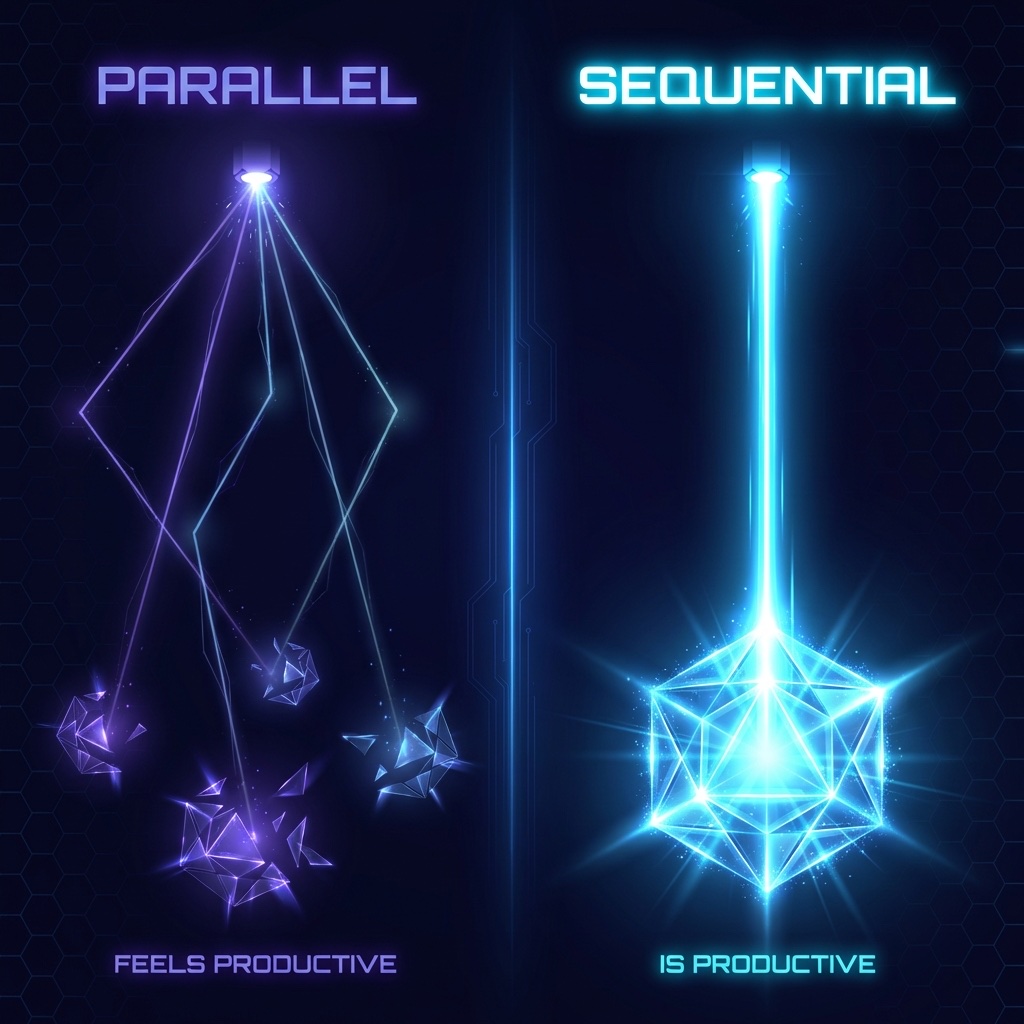
Should you work sequential or parallel? It depends on three things.
Energy. If you’re running on fumes, parallel work becomes catastrophically wasteful. Low-energy parallel work produces garbage at the speed of light. When energy is low, go sequential — one thing, done well, then stop.
Purpose. Administrative tasks, low-stakes coordination, routine execution — these tolerate parallel. Creative work, strategy, architecture, writing, problem-solving — these demand sequential. Match the mode to the cognitive load.
Quality. If the output needs to be excellent, sequential is non-negotiable. If “good enough” is genuinely good enough, parallel can work. Be honest about which standard applies. Most people default to parallel on work that actually demands sequential.
The higher the stakes, the more sequential you should be.
The Constraint That Will Eventually Dissolve
There’s a future where this changes. When AI agents produce work you’d sign your name to without editing — when the quality gap between their output and your best thinking closes to zero — the bottleneck moves. You stop being the builder and become the architect. Parallel orchestration becomes viable because the shaping, the judging, the taste-making happens inside the agent, not inside your overtaxed prefrontal cortex.
We’re not there yet.
Right now, you are the shaper. You are the judge. You are the visionary who decides whether an output is good enough to exist in the world. Every AI pipeline, every agent factory, every automated workflow still funnels through your cognition for the decisions that matter most. And that cognition — the one resource you cannot parallelize — degrades every time you split it.
While you are training AIs, building pipelines, and shaping agent workflows, the limitation is still on you. The quality function runs on a single thread. Treat it accordingly.
One Thread at a Time
The neuroscience doesn’t care about your productivity system or your fleet of agents. It says: your brain does one thing at a time, whether you admit it or not. Every “parallel” task is just sequential with extra overhead and worse output.
You can fight this and feel busy. Or you can accept it and do the work that only you can do — one thing at a time, with your full mind behind it.
Multitasking feels productive. Your brain disagrees.