


Bear Off First
Ten projects at eighty percent is zero projects shipped. You can push work forward across a dozen fronts and feel like a machine, but until something crosses the finish line, you have delivered nothing. In backgammon, the only move that actually scores is bearing off, removing a piece from the board entirely. Everything still in play is exposed and worth nothing until it gets home. Finishing one thing beats advancing ten.

The Board Is Full, Nothing Is Scoring
Why does everyone have fifteen things in flight? Because starting feels like progress. You open a new workstream, draft a new doc, spin up a new prototype. Each one delivers a little hit of momentum. Your board looks busy. Your standup sounds productive.
But here’s the thing about backgammon: you don’t win by having the most pieces in play. You win by getting pieces off the board. The game calls it “bearing off.” You move a piece all the way around, bring it home, and remove it from the board entirely. That piece is done. It’s scored. It can never be taken away from you.
Everything still sitting on the board? It’s at risk. Your opponent can knock it backward. You can get blocked. All that forward progress can evaporate in a single turn.
Shipped work is the only work that counts. I call this the Backgammon Principle: the move that finishes one thing is always worth more than the move that advances five things.
Every Open Project Is Exposed
Unfinished work isn’t just sitting there waiting patiently. It’s costing you.
Think about what happens to a piece that’s sitting out on a backgammon board by itself. It’s vulnerable. Your opponent can land on it, knock it off, and send it all the way back to the beginning. All of that forward progress, gone.
Your half-built feature works the same way. A priority change kills it. A reorg reassigns the team. Requirements drift while it sits. Even without any big disruption, context just quietly decays. Every day that passes means more ramp-up time when someone finally comes back to it. The cognitive cost of juggling multiple open threads is well-documented, but the strategic cost might be worse: work-in-progress is liability dressed up as progress.
Finished work can’t be taken back. That’s the asymmetry that matters. Completed work is permanent value. Unfinished work is temporary position that can be wiped out at any time.
Finishing Compounds, Spreading Collapses
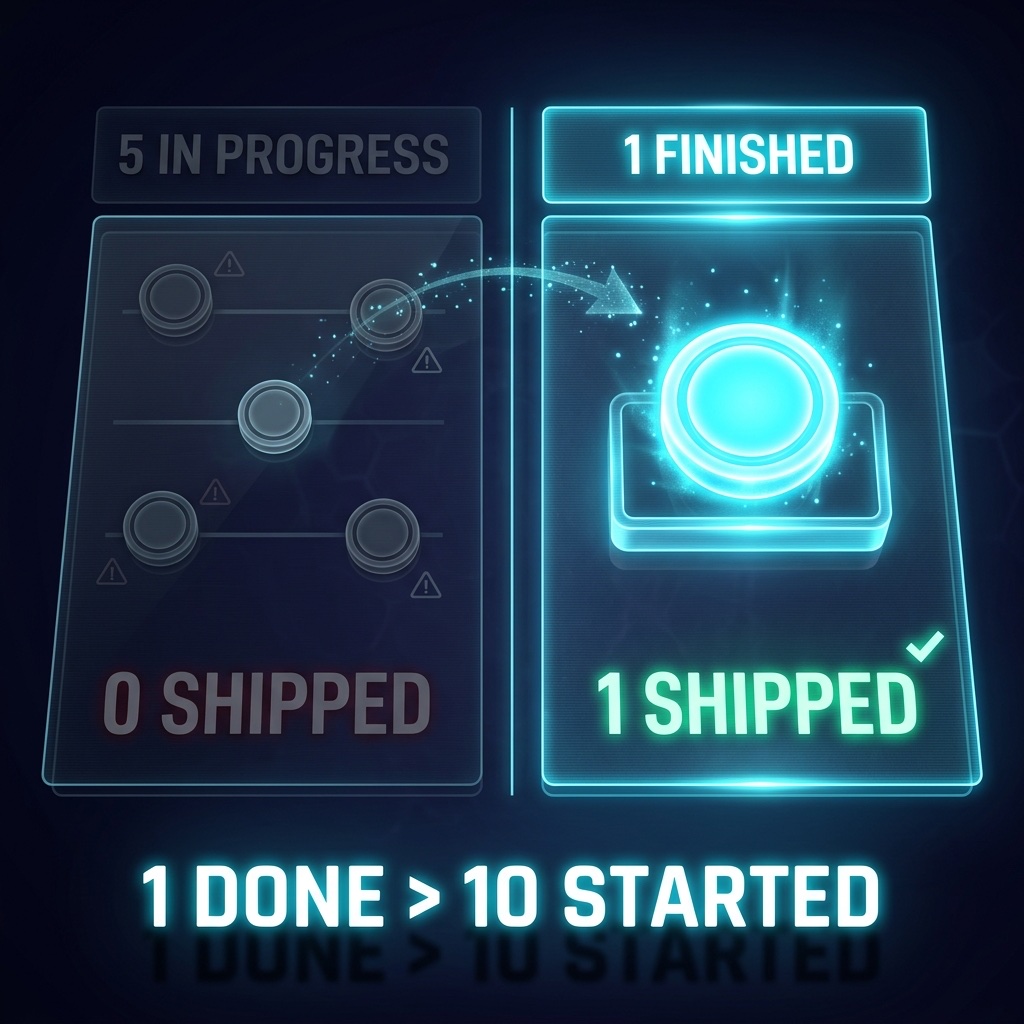
Here’s the calculation most teams get wrong. You have a week. You can either:
A. Advance five projects by 20% each. B. Finish one project entirely.
Option A feels more productive. Five things moved forward! But at the end of the week, you’ve actually delivered zero value. Five things are still sitting on your board. Five contexts to keep loaded. Five things that could get knocked backward by the next reorg or strategy pivot.
Option B delivers one complete unit of value. It’s shipped. It’s working. It’s off your board. And now your attention is fully available for the next thing. Cycle time drops because you’re not paying context-switch tax on four other threads. Flow improves because you’re moving one piece through the whole pipeline instead of clogging five stages with five pieces.
This math compounds over time. A team that finishes things builds up a growing pile of shipped value and a shrinking list of obligations. A team that advances things builds up a growing pile of obligations and a shrinking capacity to deal with any of them. This is why forward flow works. It optimizes for throughput of completed improvements, not throughput of activity.
How to Play Bear-Off
The tactics are simple. The discipline is hard.
Finish what’s closest to done. Look at everything in flight. Which item is nearest the finish line? That’s your priority. Not the most exciting thing. Not the newest thing. The one that’s almost across the line. Any backgammon player will tell you: move the piece that’s almost home before you start developing a new one.
Stop starting. Before you begin anything new, ask yourself: is there something I could finish instead? If yes, finish it. Starting is cheap and it feels great. But finishing is where all the value actually lives.
Make done smaller. If a piece of work is too big to finish this week, break it down until a shippable slice fits inside a day or two. Ship the small piece. Then tackle the next one. Microtasking is the mechanical version of this same instinct: chop the work into units that can actually cross a finish line.
Count your work-in-progress. Every item that’s open and unfinished is exposed. Every one carries risk and maintenance cost. The fewer open items you’re carrying, the stronger your position. Specification is the bottleneck in most delivery systems, and specifying five things at once means none of them get specified well enough to actually finish.
Shipped Beats Started
The world rewards output, not activity. Your customers can’t see your board. They don’t know about your twelve in-flight initiatives or your ambitious roadmap. They only see what you’ve shipped: the features that work, the products they can use, the problems that got solved. Everything still in progress is invisible to them.
An agent running five tasks in parallel looks productive. A team with thirty open tickets looks busy. A founder with ten initiatives looks ambitious. But the person who shipped something today has the only kind of progress that’s real. No invisible work, and unshipped work is the most invisible work of all.
Bear off first. The board will still be there when you’re ready for the next piece.