


Product Review Is the Future
Code review is dying. When agents own the code, staring at diffs is the wrong job. But that leaves a vacuum. If senior engineers aren’t reviewing pull requests, what are they reviewing? The answer is the product itself — its surfaces, its behaviors, its capabilities. Product review is the emerging discipline that fills the gap, and the teams that figure it out first will ship circles around everyone else.

The Review Gap
Most teams today have exactly one review mechanism: the pull request. Every change funnels through the same narrow pipe — a text diff of source code. Bug fix? Diff. New feature? Diff. Architecture change? Diff. UX overhaul? Believe it or not, diff.
This made sense when the diff was the product. When a human wrote every line, reading the code was the most efficient way to understand the change. I wrote yesterday about why code review is a dying practice.
But we’ve blown past that point. Agents generate thousands of lines per day. The diff is no longer a useful lens. It’s like reviewing a building by reading the bricklaying instructions instead of walking through the rooms.
Product review replaces the diff with the thing the diff produces.
The Review Surfaces
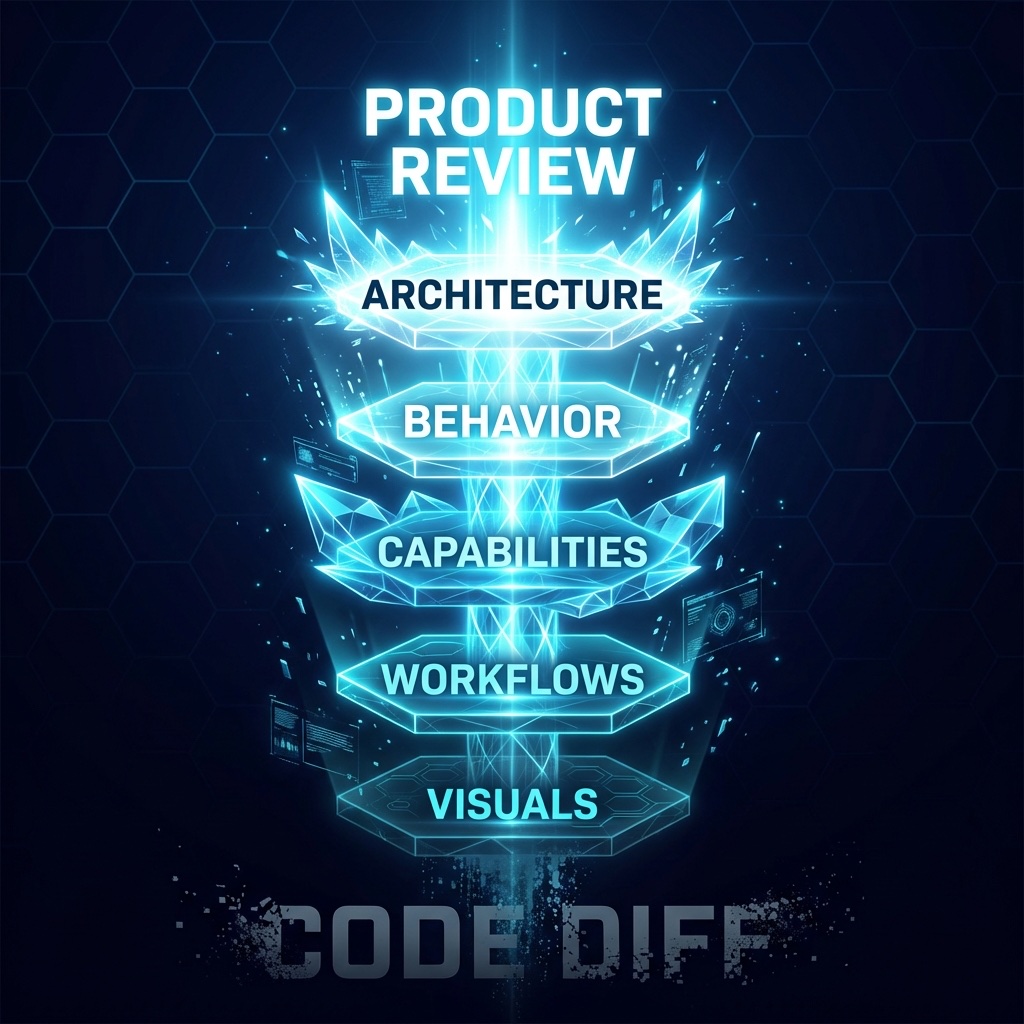
Product review isn’t one thing. It’s a collection of surfaces — each one giving humans a high-fidelity view of what the system does without requiring them to read how it’s implemented.
Visual Interfaces
Tools like Storybook and Chromatic already solve this for UI components. You see the rendered component. You see what changed visually. You approve or reject the appearance, not the JSX that produces it. Visual regression testing makes this automatic — a screenshot diff is infinitely more useful than a code diff when the question is “does this look right?”
This extends beyond component libraries. Full-page screenshots, interactive previews, deployed staging environments — any mechanism that lets a human see the product as a user sees it.
Workflows
This is the frontier. WorkLoops is pioneering a domain-specific language for composable, atomic workflows — human-readable and machine-executable. When your workflows are declared explicitly, a reviewer can inspect the flow of work without digging through implementation code.
Event modeling takes this further. When you diagram the events, commands, and read models of a system, you’re reviewing the business process itself. Not the code that implements it — the process it encodes.
Capabilities
Every system exposes capabilities. The question is whether those capabilities are reviewable without reading source code.
OpenAPI specs make API surfaces reviewable. A human can scan the endpoints, request shapes, and response contracts and understand what the system can do. CLI help menus do the same for command-line tools. Feature flags and capability matrices document what’s on and off.
When capabilities are declared as artifacts — not buried in implementation — they become review surfaces. You’re reviewing the contract, not the code behind it.
Behavioral Specifications
Given-When-Then isn’t just for test automation. It’s a review format. When behavior is specified as scenarios, a product owner or senior engineer can read and approve the behavior without ever seeing the implementation.
Given a customer has items in their cart
When they apply a valid discount code
Then the total decreases by the discount amount
And the discount appears on the receipt
A human reads that and knows exactly what the system does. No code required. This is product review in its purest form — reviewing what happens, not how it happens.
System Diagrams
Architecture decision records. Event modeling diagrams. Domain maps. Data flow visualizations. These are the blueprints of the system — reviewable at the altitude where humans actually add value.
When an agent makes a structural change, the review isn’t “did you indent this correctly?” It’s “does this event flow still match our business process?” That’s a question a human can answer by looking at a diagram. It’s not a question you answer by reading a diff.
The Pattern
Every one of these surfaces follows the same pattern: separate the reviewable artifact from the implementation artifact.
Code is the implementation artifact. It’s what agents produce. It’s optimized for machines to write and machines to execute.
The review surfaces — screens, workflows, specs, capabilities, diagrams — are what humans produce and consume. They’re optimized for human comprehension, human judgment, human approval.
The best teams will have two parallel artifact streams: one for agents (code, tests, configs) and one for humans (visuals, specs, workflows, diagrams). The agent stream moves at machine speed. The human stream moves at the speed of understanding. Both are necessary. Neither replaces the other.
Building Your Review Stack
This is a burgeoning area. The tooling is immature. Most teams don’t have a coherent product review practice — they have fragments. Some visual testing here, some API docs there, maybe a behavioral spec suite that nobody maintains.
The teams pulling ahead are assembling a deliberate review stack:
| Surface | Tools | What You Review |
|---|---|---|
| Visual interfaces | Storybook, Chromatic, Percy | Does it look right? |
| Workflows | WorkLoops, event modeling | Does work flow correctly? |
| Capabilities | OpenAPI, CLI help, feature flags | Can the system do what we need? |
| Behavior | Given-When-Then, scenario specs | Does it act correctly? |
| Architecture | ADRs, domain maps, event models | Is the structure sound? |
No team has all of these fully operational yet. That’s fine. The direction matters more than the completeness. Every week, you should be reviewing more product and less code. Build the surfaces that let you do that.
Review the Product, Not the Implementation
The engineers who thrive in the next era won’t be the ones who can read the most code. They’ll be the ones who can evaluate a product through its surfaces — its visuals, its workflows, its capabilities, its behaviors, its structure.
Code review asked: “Is this code correct?” Product review asks: “Does this product work?”
That’s a better question. And it’s the question humans are uniquely equipped to answer.