


From Conversations to Work Requests
Every agent harness today is a conversation manager. Sessions, threads, history, compaction, resume, and rewind all exist to keep a conversation going. That design made sense when one person drove one agent and carried the actual work in their head. Run twenty agents and the work outlives every conversation it passes through, and a harness that only understands conversations can’t tell you where any of it stands. The next generation of harnesses will be built around the work instead.
Harnesses Manage Conversations
Look at what today’s harnesses are good at. Claude Code, Cursor, Codex, and the rest can start a session, stream a turn, call tools, compact a long history, resume yesterday’s thread, and fork a subagent. Every one of those features exists to keep a conversation alive and coherent.
The multi-agent features follow the same pattern. A subagent is a conversation spawned by a conversation. The status dot next to a session answers one question: is this conversation waiting for input?
Nobody can ask the harness the question that matters when you run a fleet. Where is the work?
The Work Outgrew the Conversation
A real piece of work doesn’t fit in one conversation anymore. It starts in one session and gets handed to another. It waits a day on a human approval. A third agent picks it up after a crash, and it spawns two more tasks along the way. Conversations start and stop around it constantly, and the work keeps going.
A conversation manager has no place to put that. So the human becomes the work tracker. You click through tabs to figure out which sessions finished and which are stuck or waiting on you. “Where are we?” becomes your most-typed prompt. The transcript becomes the database.
Everyone running agents at scale is hitting this wall. A developer who runs about thirty sessions a day wrote: “At 30, the cost is not switching, it is not knowing which one to switch to.” Another asked for a cross-session inbox, because everything that needed their attention existed “only as prose inside one session’s transcript.” And when an agent does end its turn, its own word is all you get. Anthropic’s engineering team writes that Claude “declares victory on the entire project too early.”
These aren’t bugs in any one tool. They come from the primitive. A conversation has no definition of done. It just stops.
Work Harnesses
The next harnesses will treat the work request as the primitive and the conversation as a disposable worker.
Conversations are disposable. Work requests are durable.
A work request carries what a conversation never had: who asked, which role owns it now, what state it’s in, what it’s waiting on, and what it has produced so far. A conversation picks up a request, does a slice of the work, and puts it down. The next conversation starts fresh from the request.
Anthropic describes long-running agents as shift workers, where “each new engineer arrives with no memory of what happened on the previous shift.” Factories solved that problem a century ago by putting a work order on the part. Workers rotate. The work order travels with the work.
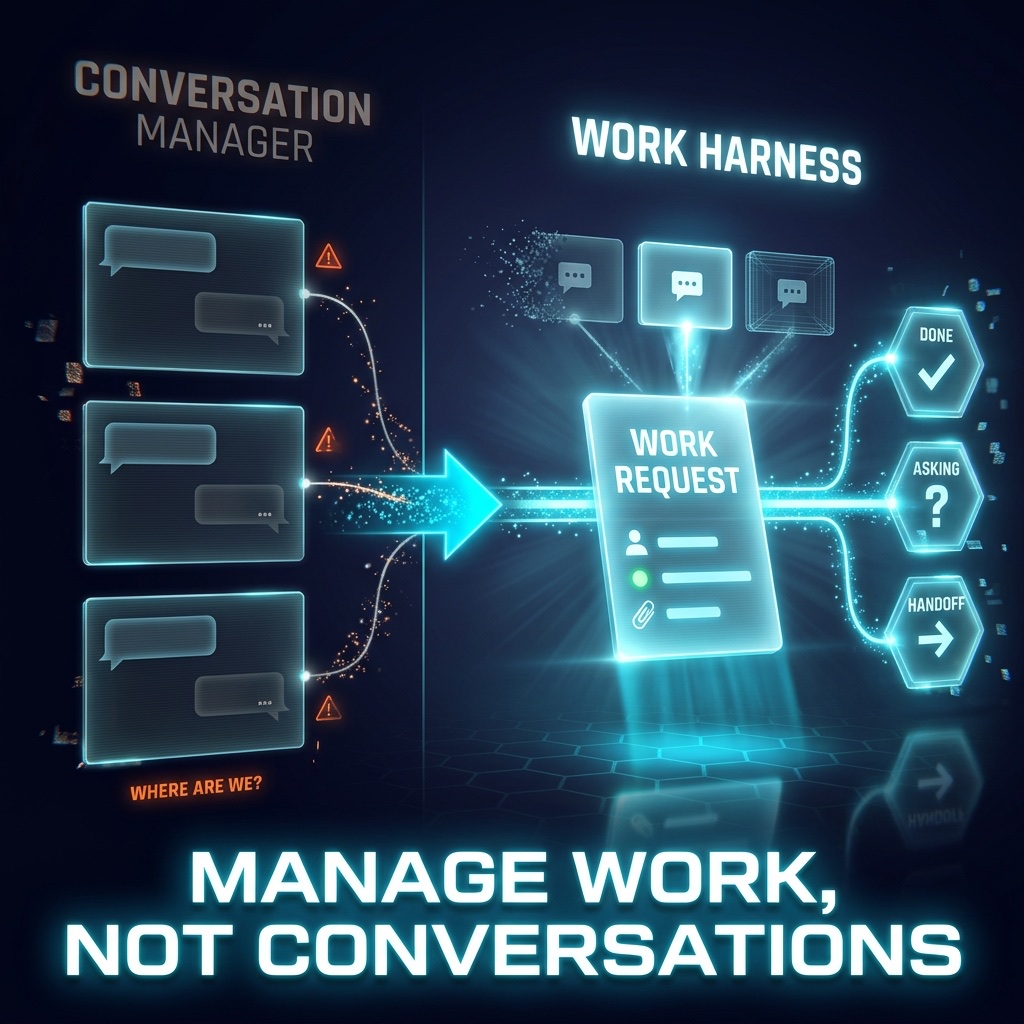
| Conversation manager | Work harness | |
|---|---|---|
| Unit | session | work request |
| Memory | transcript and compaction | the request and its artifacts |
| How a turn ends | it stops | done, asking, or handed off |
| Who decides it’s done | the agent says so | proof attached and checked |
| Failure | an error message | a question routed to someone who can fix it |
| Status | read the transcript | query the ledger |
| Your job | watch tabs | answer a ranked queue of decisions |
The biggest change is the third row. In a work harness, no conversation is allowed to simply stop. Each one puts the work down in exactly one of three states: done, with proof; asking a specific role, with the thing to judge attached; or handed off to a role, queued behind whatever it waits on. Failure is just an ask aimed at whoever can route around it.
The harness enforces this in code. A session that tries to end without saying where the work goes gets held. If it quits anyway, the work goes back to a shared pool instead of vanishing.
With a record on every stop, asks for humans become a decision queue. Asks for other roles wake the right agent. Handoffs start the moment their dependency clears, and “where are we?” turns into a query.
The Pieces Are Already Showing Up
You can see the industry reaching for this. Google’s A2A protocol defines a Task with states like working, input required, and completed. MCP added async tasks. Linear lets you delegate issues to agents but assign them only to humans. Claude Code’s Projects view sorts threads into Waiting on you, Working, and Idle. Devin can require a structured final output before an agent’s turn ends.
Each of these bolts a piece of the work model onto a conversation manager, and none of them owns the ending. In A2A, the worker marks its own task completed. Questions go to whoever started the session. Claude Code’s Stop hook can block an agent from ending its turn, but after eight blocks it gives up and the work goes nowhere.
The ending still belongs to the model. The next harness takes it away.
Build the Ending Now
You don’t have to wait for it. The core of a work harness is a small record and a hook, and both fit on top of the harness you already use.
Every turn ends by writing one record:
{
  "status": "handoff",
  "to": "engineering",
  "summary": "Checkout validation done; needs an end-to-end run on staging",
  "after": "task-412",
  "artifacts": [{ "path": "src/checkout/validate.ts" }],
  "not_done": ["Not tested on mobile Safari"]
}
A deterministic hook checks for it when the turn ends. A plain chat answer gets recorded as done automatically. A turn that did real work and stopped without a record gets held once, and a second silent stop writes a handoff to the shared pool. The tool that writes records refuses “done” while any listed artifact is uncommitted. Agents break any rule you don’t test, so this rule lives in code.
The harness that wins the next round will be the one that never loses a piece of work, no matter how many conversations it passes through.