


Decisions Are the New Unit of Work
Everyone runs agents in parallel now. Some you drive by hand, some run under a Digital Employee, and on any given morning there are dozens of pieces of work in flight across several projects. Keeping all of that busy is a solved problem. The hard part now is knowing which of it needs you, and which of it is worth anything. Most agent dashboards list every session and pull request, oldest first, when what you actually need is a short list of the decisions only you can make, ranked by how much they matter.

The Status Lights Work
Agent tooling has settled on the same handful of states: working, needs input, done, error. Claude Code’s agent view flags the sessions waiting on you. GitHub’s Agent HQ puts Copilot, Claude, and Codex into one mission control. People who want more build it themselves in tmux. When I had five agents in flight back in May, I put an owl in a $30 crystal cube just so I could see who was awake.
All of these tools answer one question: who is waiting on me?
That question is too small. Every queue I’ve seen sorts by status, then by age. Blocked first, oldest first. That rule will happily put a dependency bump ahead of a pricing decision because the bump has been sitting there longer. You clear the queue top to bottom, feel great about it, and the work that mattered is still waiting at lunch.
More Work, Same Results
The numbers are starting to show it. A Harvard working paper by Fiona Chen and James Stratton (summarized here) looked at engineering data from about 700 companies. After teams adopted coding agents, they wrote roughly 30% more code and opened 23% more pull requests. The number of issues they resolved didn’t move in any statistically meaningful way. Merge times went up 49%.
More output. Same outcomes. Longer queues.
Agents can generate work forever. They can’t tell you which of it was worth generating. Left alone, a swarm fills every hour with polished, low-value work, and somebody still has to look at all of it.
You Get About Three
The human side has a hard ceiling. A BCG survey of nearly 1,500 US workers, published this spring, found productivity climbing with the first, second, and third AI agent, then dropping at the fourth. People who reported mental exhaustion from juggling agents had a third more decision fatigue and made 39% more major errors. Simon Willison described his own limit plainly: “I can only focus on reviewing and landing one significant change at a time.”
Your attention isn’t growing. The pile of work is. Hopping between twelve sessions feels productive and burns the few good slots you have on whatever happens to be on top.
Manage Decisions
Every piece of work in flight is in one of two states. Either it’s moving on its own, or it’s waiting on a decision. A decision is any point where the work can’t continue without a human call: approve this, pick that option, ship it, redirect it, kill it.
Work that’s moving doesn’t need you. Work that’s waiting is stuck, and the only thing that unsticks it is somebody deciding. So the thing you actually manage is the decision. Sessions and pull requests are just where decisions happen to be hiding.
Decisions are the new unit of work.
That changes what the dashboard should show. Forty sessions with colored dots tells you almost nothing. You want a short, ranked list of decisions, and each entry carries four things:
- what’s being decided, in one plain sentence
- the options, with the agent’s recommended default
- what it unblocks
- what it’s worth, and what waiting costs
Rank it by value and by how much other work it frees up. Age is a tiebreaker at best.

Same Morning, Two Ways
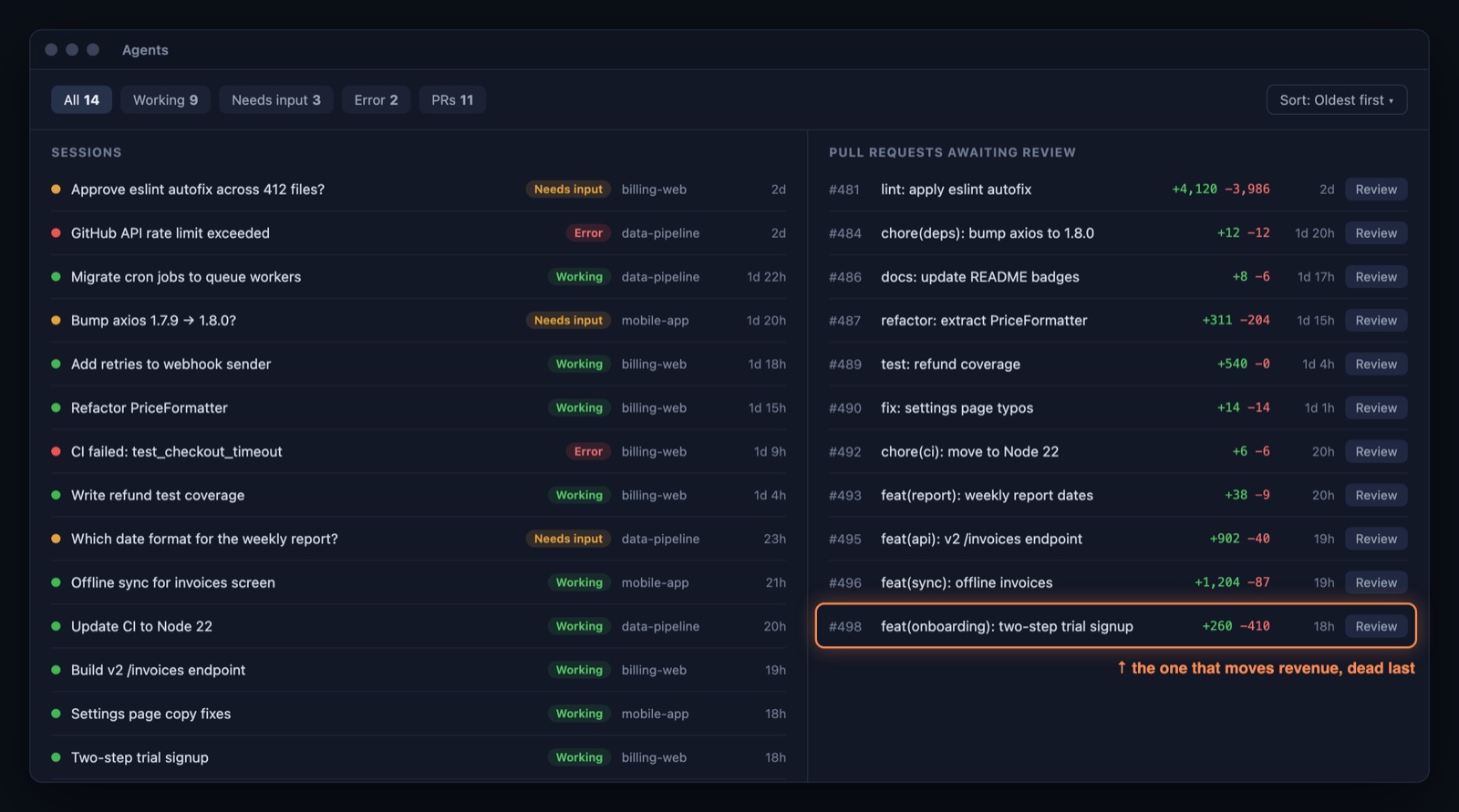
Take a morning with fourteen agent sessions and eleven open pull requests spread over three projects.
In the session view, nine are green, three need input, and two show errors. You start at the top. You approve a lint fix, then a dependency bump. You answer “which date format?” for an internal report. You read an error log that turns out to be a flaky test. It’s 11 a.m., your head is full, and the onboarding change that’s supposed to lift trial conversion has been waiting since yesterday because it landed after everything else.
In the decision view, the agents already settled the lint fix, the bump, and the date format, because all three are cheap to reverse and nobody will care. They sit in a log you can skim on Friday. The flaky test got retried and quarantined without you. What’s left is four decisions. The onboarding change is at the top because it touches revenue and unblocks two other branches. You make that call in ten minutes with a fresh head, and the other three take twenty.
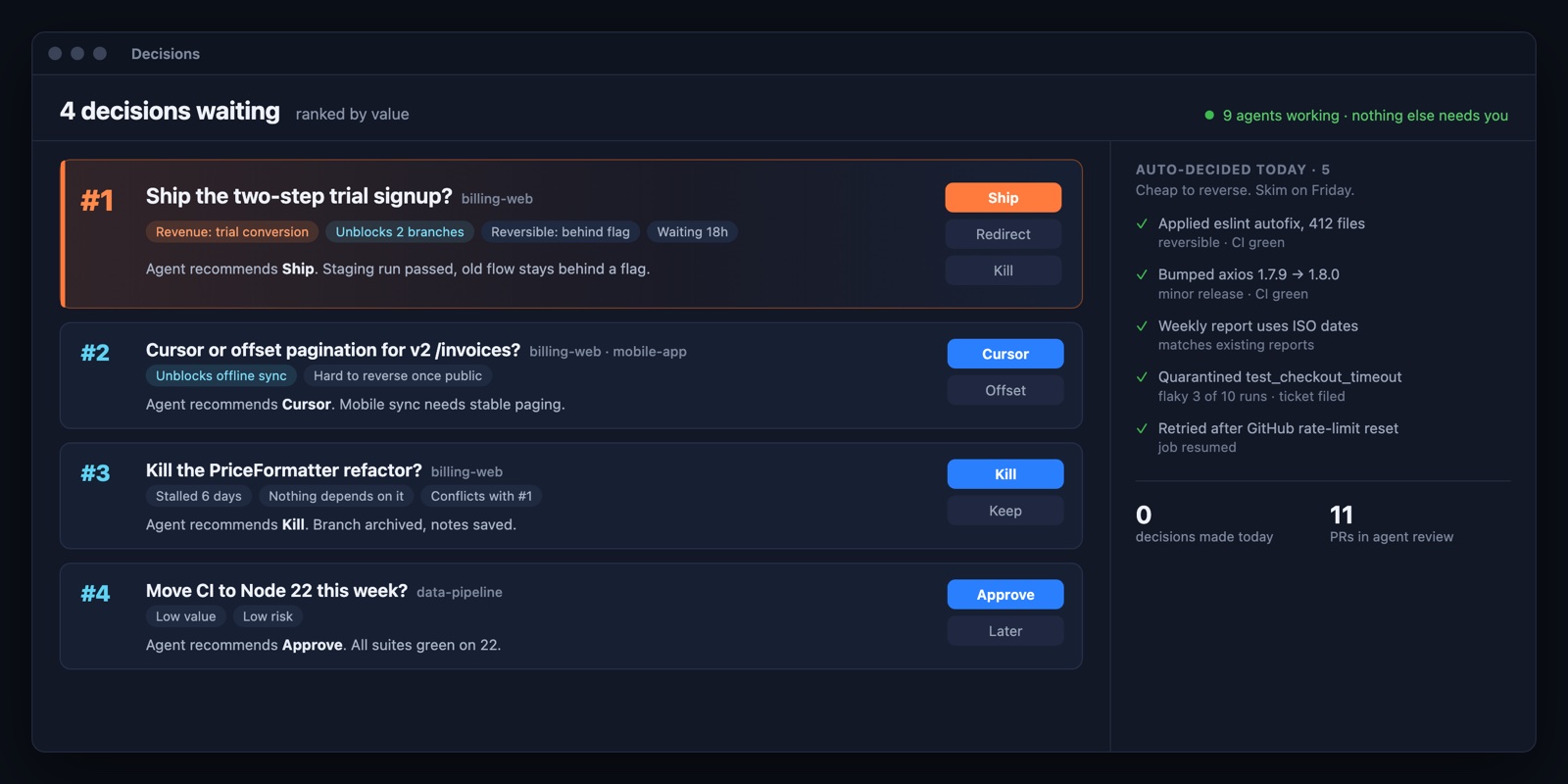
Same agents, same work. Your best hour went to the decision that mattered.
Rules for a Decision Queue
Agents decide what they can. If a call is cheap to reverse and low-stakes, the agent makes it, picks the sensible default, and logs it. It never reaches you. Back-and-forth was already the bottleneck with one agent. With twenty, every routine approval you click is a slot you didn’t spend on something real.
Every decision arrives with a recommendation. “Which option do you want?” with no default is unfinished work. The agent did the research, so it should say what it would do and why, and most decisions become a quick yes. Better still, make the call before the work starts. A lot of agent questions are really a spec that was never written.
Rank by value and blast radius. Revenue, customers, anything irreversible, and anything that frees up other work go to the top. Formatting goes in the log.
Kill on purpose. Work that has waited a week with no decision coming is already dead, so make it official. Ten branches at eighty percent are worth nothing until something bears off.
Watch for rubber stamps. If you’re approving complex changes in two seconds each, the queue has too much in it. Push more calls down to the agents, or start less work.
Stop counting your agents and your pull requests. Count your decisions: how many you made today, how many are waiting, and what the top one is worth. Agents made work cheap. Your judgment didn’t get any cheaper, so spend it where it pays.