


Everything Should Be One Message Away
Management was a routing technology before it was a leadership philosophy. When a company got too large for one person to see the whole board, hierarchy became the compression layer: managers collected signals, filtered noise, relayed priorities, and checked whether the work happened. The internet connected everyone, but it did not make the company legible or executable from one place. AI changes that, because the right workspace turns almost every information-bound task into one message away.

The old company was built around distance.
Distance between the question and the answer. Distance between the decision and the person with context. Distance between the strategy and the hands that could execute it. Distance between the customer signal, the dashboard, the Jira ticket, the code change, the deployment, and the person accountable for the result.
Hierarchy existed because distance had to be managed.
One person could not monitor every customer, every metric, every project, every failure mode, every employee, every commit, every sales call, every incident, and every promise. So companies built layers. Directors watched managers. Managers watched teams. Teams watched tools. Tools watched fragments of reality.
Then mandates moved the other direction. A CEO said something. An executive translated it. A director scoped it. A manager assigned it. A team interpreted it. A ticket appeared. Someone did the work. Eventually.
This was not stupidity. It was an information architecture.
The internet made the pipes faster, but it did not remove the routing problem. Everyone got email. Everyone got Slack. Everyone could technically message everyone else. But the actual operating knowledge of the company still stayed scattered across people, dashboards, tools, meetings, documents, and private memory.
That is why real-time chat created so much noise. I wrote years ago about how Slack harms projects because messaging without completed context just accelerates interruption. It gives you low-latency communication, not low-latency execution.
The same pattern shows up in lean terms as motion waste: every back-and-forth needed to transfer information before work can happen. A status meeting is motion waste. A “who knows this?” thread is motion waste. A manager manually translating a goal into six different tool updates is motion waste.
AI-native organizations attack motion waste directly.
Message Distance Is the New Org Chart
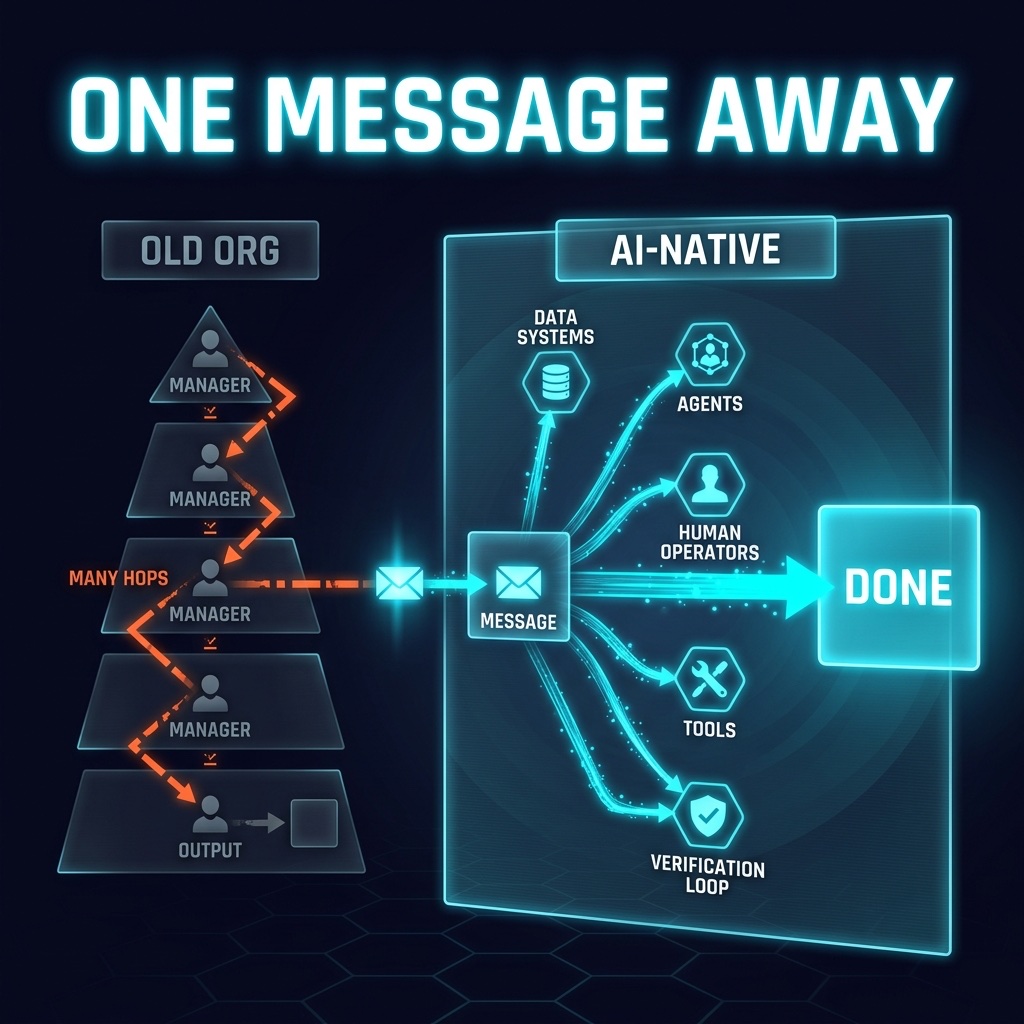
The important metric is no longer headcount, reporting depth, or meeting cadence.
The important metric is message distance.
How many messages does it take to answer the question?
How many messages does it take to change the system?
How many messages does it take for a strategy to become a shipped artifact?
In the old model, “What is happening with enterprise onboarding?” might require a director, two managers, one analyst, one support lead, three dashboards, and a follow-up meeting. In the AI-native model, the correct answer is one message:
“Summarize enterprise onboarding risk this week across HubSpot, Linear, Slack, support tickets, call transcripts, and production logs. Include the three accounts most likely to slip, the blockers, the owner, and the next action.”
That query should return the answer.
Not because the model is magical. Because the company has done the work to make the company queryable. The data is connected. The permissions are scoped. The terminology is documented. The agent can reach the systems where reality lives.
This is why data connectors unlock everything else. A disconnected agent turns the founder back into the lookup service. A connected agent turns the company into a surface area for questions.
The same rule applies to execution.
“Create a weekly churn risk report” should not become a project proposal, a planning meeting, a dashboard ticket, a handoff to data, and a follow-up thread asking whether the report is ready. It should become one message to the right agent in the right workspace:
“Build the weekly churn risk report. Use Stripe, product usage, support tickets, and CRM stage changes. Draft it in the executive format. Schedule delivery every Monday at 8 a.m. Send me the first run for review.”
That does not mean the agent gets unlimited power. It means the agent workspace contains the tools, context, credentials, and guardrails needed for that class of work.
Every missing connector, missing permission, missing glossary, missing playbook, and missing verification step adds another hop.
Hops are latency.
Hops are distortion.
Hops are where companies leak execution.
Stop Being the Routing Layer
Most leaders are still the router.
They ask the question. Someone sends a partial answer. They ask another person. Someone pastes a screenshot. They compare it against a dashboard. They message a team lead. They carry context from one thread into another. They summarize the summary. They decide. Then they spend the rest of the week making sure the decision survived translation.
That job felt inevitable because no tool could hold enough context to replace the routing layer.
Now the routing layer is software.
When you spend forty-five minutes gathering facts for an agent, you are the human API. When a person has to translate the same instruction into five operational systems, they are the human orchestration layer. When a manager has to ask three people for status before answering a customer, the company is still organized around human relay.
That is the wrong shape now.
The right question is the one I keep returning to: why can’t AI do it?
If AI cannot answer the query, what is missing?
If AI cannot execute the task, what is blocked?
If AI cannot verify the result, what loop is open?
Each failure identifies a structural defect in the company. Not a model defect. A company defect.
No access. No context. No tool. No permission. No rubric. No owner. No eval. No source of truth.
Fix those, and the hop count drops.
One Message Does Not Mean One Human
The one-message company is not a cult of the omniscient CEO.
It is the opposite. It is an organization where information is externalized enough, tools are connected enough, and agents are specialized enough that the right work can be routed directly to the right executor without ceremony.
Sometimes the executor is a person.
Sometimes it is an agent.
Often it is both: a person supplying intent and judgment, an agent gathering context and doing the mechanical work, an operator verifying the output. That is why operators are the missing role in serious agent systems. The human does not disappear. The human stops being the courier.
This is also where naive automation breaks. “One message away” only works when the message contains enough intent. AI did not eliminate the need for specification. It made specification the bottleneck. The better the company gets at expressing intent, constraints, defaults, and success criteria, the more work becomes directly executable.
The future org chart is not a pyramid.
It is a capability graph.
Nodes are people, agents, tools, datasets, playbooks, evals, and approval boundaries. Edges are explicit permissions and communication paths. The goal is not to make everyone report to one person. The goal is to make every important query and every information-bound task reachable through the shortest safe path.
The shortest safe path should usually be one message.
Build for One-Hop Work
Here is the operating standard:
If a task is software-bound or information-bound, it should be one message away from done.
Not one meeting. Not one planning cycle. Not one chain of status updates. One well-formed message to the correct person or agent, in a workspace where the necessary context and tools already exist.
If that sounds impossible, good. The impossibility is the map.
Ask what would need to be true:
- What data source has to be connected?
- What tool has to exist?
- What permission can be safely granted?
- What context needs to be externalized?
- What rubric would let an agent verify the result?
- What operator owns the line?
Then close one gap.
The work compounds. A connector built once can answer a thousand future questions. A playbook written once can steer a hundred future runs. A verification harness built once can let agents close the loop without dragging a human back into the sensor role.
This is the AI-native company: not fewer humans, but fewer relays.
Fewer handoffs. Fewer translations. Fewer meetings whose only purpose is moving information from one skull to another.
Everything queryable.
Everything routable.
Everything executable.
One message away.