


That's AI Is the New Anti-Intellectualism
Someone writes a clear, well-structured argument online and the first reply is two words: “AI reply.” Not a counterargument. Not a question. A classification that ends the conversation before it starts. The person who wrote it, a real human with a real position, gets filed under “not worth engaging with” and the thread moves on. We have a new thought-terminating cliche, and it is dumber than the ones it replaced.

Anti-Intellectualism Is Old
None of this is new in structure. Only in costume.
People have always found ways to avoid engaging with ideas they cannot easily dismiss on the merits. Ad hominem is the oldest trick. Attack the speaker, ignore the speech. The genetic fallacy is its cousin: reject the idea based on where it came from rather than what it says. Both are ways to exit an argument without doing any of the work an argument requires.
Scott Adams calls this pattern “word thinking.” Substituting semantic games for actual reasoning. “Word-thinking is what happens when people try to win an argument by adjusting the definition of words,” he writes. “In these situations there is no appeal to reason.” The mechanism is old. You don’t need to grapple with someone’s point if you can reclassify them out of the conversation entirely.
For most of history, the reclassification was tribal. You’re young, so you don’t understand. You went to the wrong school. You work in the wrong field. You’re from the wrong country. Each label served as a reason to stop listening. Not because the idea was wrong, but because evaluating the idea was harder than dismissing the person.
The people who used these shortcuts were not always malicious. Most were never taught the trivium (grammar, logic, rhetoric), the basic machinery of structured thought. They could not distinguish a valid argument from an invalid one because no one ever showed them the difference. They would commit ad hominem and walk away thinking they had just won. They would demand “but can you explain X?” without understanding the depth of X or recognizing that it was orthogonal to the claim under discussion. Fallacies felt like arguments to them because no one had ever pointed out the gap.
Then AI Filled the Internet
The Dead Internet Theory stopped being a theory in 2026. Cloudflare reported that automated traffic crossed the 50% threshold in June. Bot and AI agent activity grew nearly 8,000% year over year. Researchers at Imperial College London and Stanford found that 35% of newly published websites are now AI-assisted or AI-generated. The internet is measurably less human than it was two years ago.
People have opinions about this. I call it the AI Wars. Some refuse to engage with anything that smells like machine-generated slop. I get it. Nobody wants to spend ten minutes composing a thoughtful reply to a comment that a bot vomited out in 200 milliseconds to farm engagement. That instinct is reasonable. The follow-through is where it breaks.
Because the instinct has curdled into something else. It has become a reflex. And reflexes do not think.
The New Thought-Terminating Cliche
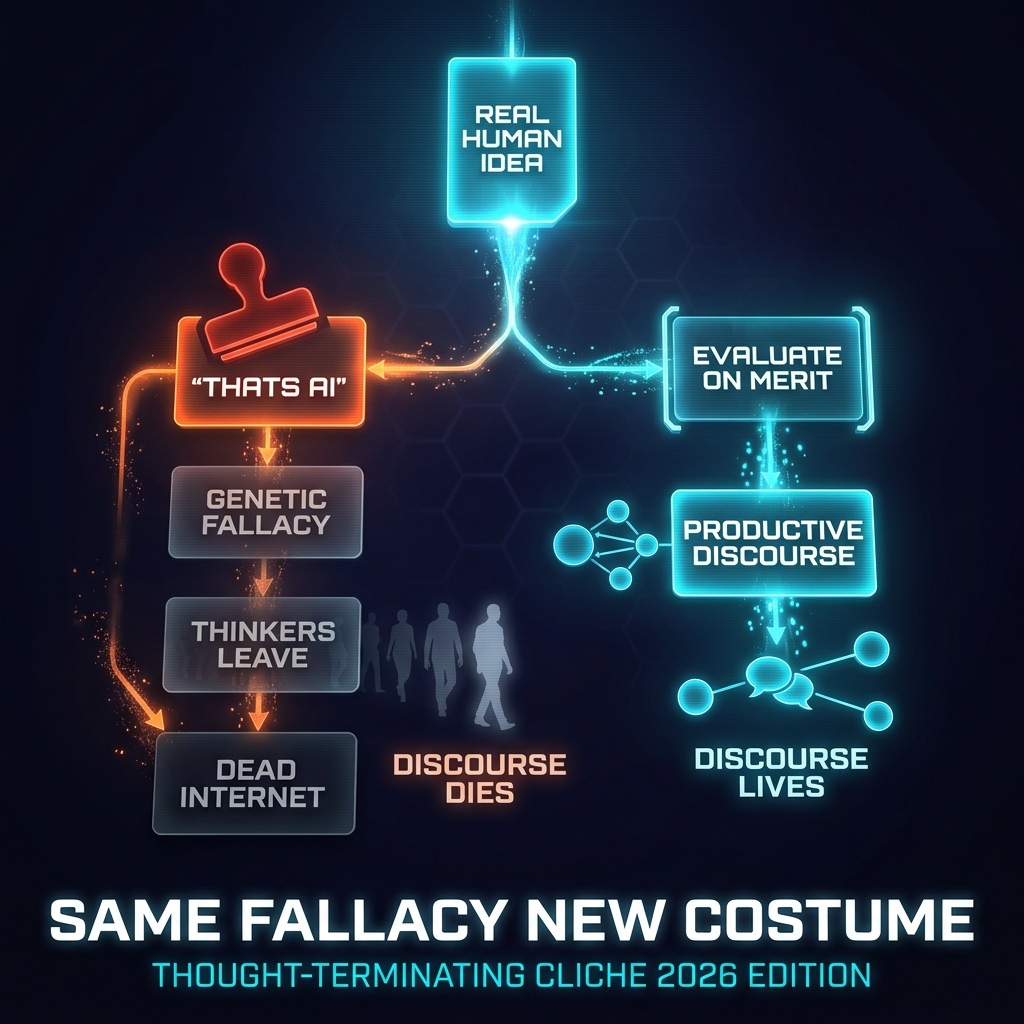
Robert Jay Lifton coined the term “thought-terminating cliche” in 1961. He described phrases that compress complex problems into “brief, highly reductive, definitive-sounding phrases, easily memorized and easily expressed” which then become “the start and finish of any ideological analysis.” The language of non-thought. It closes the door on reasoning by making the closing feel like reasoning.
“That’s AI” is the 2026 version.
It is a genetic fallacy: judging an idea by its perceived origin rather than its content. It is also factually wrong most of the time. Stanford researchers found that AI detection tools flag up to 98% of essays by non-native English speakers as AI-generated. The University of Florida concluded that commercial AI text detectors are “poorly suited for deployment in academic or high-stakes contexts.” Humans identifying AI writing perform barely better than a coin flip. The people confidently stamping “AI reply” on human-written arguments are not detecting anything. They are performing a gesture that lets them avoid thinking.
The validity of a proposition does not depend on who or what produced it. A correct argument is correct whether a human wrote it, an AI wrote it, or a monkey with a typewriter wrote it. Dismissing it because you suspect the wrong entity held the pen is not skepticism. It is the same anti-intellectual reflex wearing new clothes.
And it is worse than the old versions, because at least the old ad hominem required you to know something about the speaker. “That’s AI” requires knowing nothing at all. You don’t have to identify the person, understand their background, or even read what they wrote. You just stamp the label and walk away. It is the lowest-effort dismissal in the history of intellectual cowardice.
The Irony That Should Terrify Everyone
Here is what the “that’s AI” crowd does not seem to understand: they are accelerating the thing they claim to oppose.
If every polished comment, every well-structured post, every argument that uses vocabulary above a tenth-grade level gets reflexively dismissed as machine-generated, the humans who write those things will stop posting. Why bother crafting a careful response if the reward is being called a bot? Why engage with strangers if the engagement itself gets invalidated before anyone reads it?
The thoughtful humans are going to leave. Or they are going to retreat into private circles, group chats, invite-only communities where people already trust each other enough to read before reacting. The public internet will be left to the people who dismiss everything and the bots they claim to be fighting. That is the Dead Internet. Not because the machines took over, but because the humans who had something to say gave up saying it in public.
The alternative trajectory is pure intellectual stratification. The thinkers build private networks. The public internet becomes Idiocracy’s comment section. The people who could tell the difference between a good argument and a bad one have no reason to participate in forums where the first reply to any good argument is “nice ChatGPT essay bro.”
Ideas Deserve Evaluation on Their Merits
I do not have a clean solution. I don’t think anyone does. But I know what the prerequisites look like.
First: learn to evaluate an idea independent of its source. This is not a new skill. It is literally Logic 101: separate the argument from the arguer. A claim is true or false, valid or invalid, supported or unsupported. Who or what generated the words is irrelevant to that evaluation.
Second: accept that you cannot reliably detect AI writing. You can’t. The tools can’t. The research is definitive. If your entire engagement strategy rests on a classification you cannot accurately perform, your strategy is broken.
Third: decide what you actually want from online discourse. If you want to engage with interesting ideas, engage with the ideas. If you want to feel righteous about avoiding AI slop, you are going to end up avoiding a lot of real people with real things to say. The mirror version of getting the AI you ask for is getting the internet you participate in. If you refuse to engage with anything that sounds smart, you will only have dumb conversations left.
The current path leads to two dead ends. A dead internet where nobody real participates. Or an intellectually stratified internet where real discourse only happens behind walls. Both outcomes are failures. Both are the direct result of people treating “that’s AI” like an argument when it is nothing more than a refusal to think.
I don’t have the fix. But I know that “that’s AI” as a conversational closer is exactly as stupid as “you’re young, you wouldn’t understand” or “that’s just your opinion.” It is a costume change on the same ancient laziness.
The only people who benefit from thought-terminating cliches are the people selling you simple answers. And “that’s AI” is a very simple answer to a world that just got very complicated.