

Intelligence Wants to Be Property, Not a Service
Every serious political and economic argument about AI eventually collapses into one question. Not left vs. right. Not West vs. East. Not safety vs. acceleration. The real divide is simpler: does your strategy increase someone’s ability to act without your permission, or does it increase their dependence on asking? That single test cuts through more rhetoric than any ideological framework. The forces pushing intelligence toward possession and the forces pulling it toward rental are the defining tension of this decade.

The Abundance Coalition
On one side, a loose coalition is working to make machine intelligence something you can own, run, modify, and deploy without asking anyone.
Hugging Face, Mistral, DeepSeek, Alibaba’s Qwen team, and the broader open-model community are pushing capable models into the world under permissive licenses. The cost of possessing intelligence (not renting it) drops every quarter. In July 2026, Meta, Microsoft, Nvidia, Mistral, Mozilla, Hugging Face, OpenAI, and others signed a joint letter arguing against premature restrictions on open-weight AI. That coalition is strange and fractured, but the shared interest is real: they all benefit when capability is cheap, portable, and unsupervised.
Beyond models, the pattern repeats. Cheap inference. Competing chips. Local deployments. Renewable energy making compute less scarce. Open standards that let tools interoperate without a central broker. Every time a formerly scarce resource gets commoditized below the threshold where you need permission to use it, the abundance side wins a round.
This is what building exactly what you want looks like at the macro scale. When the model is yours, the tools are yours, and the compute is yours, nobody gets to decide what you build with them.
The Control Coalition
On the other side, a different set of actors benefits when capability exists but access remains conditional.
The clearest cases are authoritarian states. Governments using censorship, surveillance, and information control to preserve political power are optimizing for control by definition. Freedom House reports global internet freedom declined for a 15th consecutive year in 2025. China, Russia, Iran, and Myanmar are obvious contemporary examples of highly constrained digital environments, though their tech sectors simultaneously produce abundance-enhancing technology. The map is not clean.
Then there are structural chokepoints. If a small number of actors control frontier compute, cloud infrastructure, semiconductor fabrication, capital, or distribution, they can charge rents and decide who participates. Hyperscalers remain positioned to benefit from the AI buildout. Advanced chips remain subject to geopolitical access controls. The chokepoint holder does not need to be evil. They just need to be unavoidable.
Finally, some institutions argue that unrestricted model proliferation creates genuine security risks. Anthropic’s Dario Amodei has publicly argued that sufficiently powerful open-weight models may be difficult to monitor once released. That is a control-oriented architecture. Its motivation may be legitimate risk reduction rather than domination. But the architecture is the same: a gatekeeper stands between the user and the capability.
Both Games at Once
Here is what makes the map interesting: the most important actors play both games simultaneously.
Nvidia wants enormously more compute deployed and occupies a critical infrastructure position. Meta advocates open models and operates giant centralized platforms. The United States promotes technological innovation and restricts access to strategically important chips. Chinese AI labs like DeepSeek and Alibaba push remarkably open models while operating under a highly controlled political system.
This is why “China = control” or “Big Tech = bad” fails as analysis. Every major player has one foot in abundance and one foot in control. The question is not which team they wear on their jersey. The question is what their actions do to the permission structure.
The same logic applies to the AI eating the middle thesis. Intermediaries whose value was standing between buyer and supplier get routed around when the buyer possesses the intelligence to find, evaluate, and coordinate directly. The intermediary’s business model was a permission tax. AI collapses it.
The Test
Stop asking “Who are the good guys?”
Start asking:
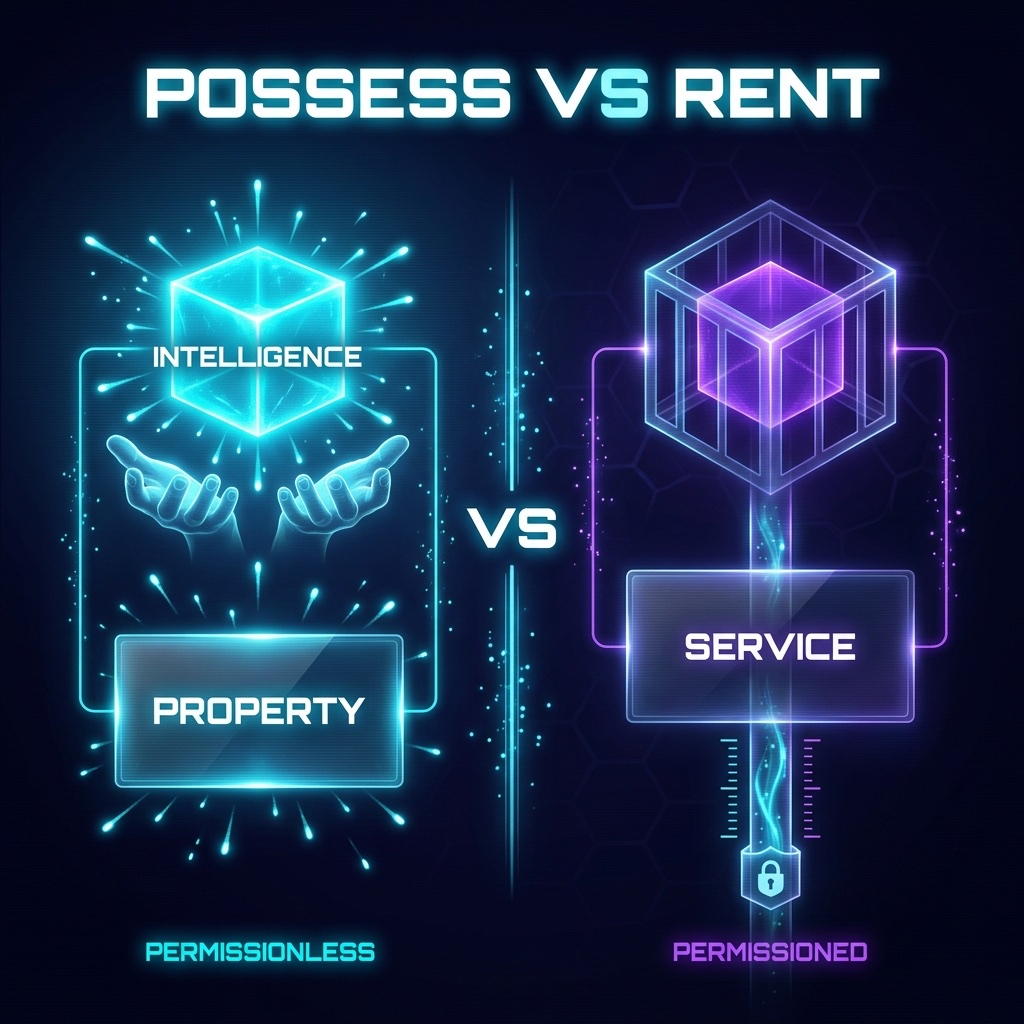
Does this actor’s strategy increase your ability to act without their permission, or increase your dependence on their permission?
That test applies everywhere:
- A model you can download and run locally scores differently than a model you can only access through an API that logs your queries and can revoke access.
- An open architecture where you own the orchestration layer scores differently than a platform where the vendor controls the workflow.
- A tool that connects your agents to your own data scores differently than a tool that forces your data through someone else’s cloud.
- An eval harness you own scores differently than a quality gate controlled by a third party.
- A chip you can buy scores differently than a chip you can only rent by the hour.
- A protocol you can implement scores differently than a platform you must join.
The pattern is always the same. Abundance means capability escapes the gatekeeper. Control means capability exists, but access to it stays conditional on the gatekeeper.
Property or Service
If the abundance coalition keeps winning, intelligence becomes something people possess. Like a book. Like a tool. Like a truck. You buy it, you own it, you use it however you want, and nobody gets to ask what you’re doing with it.
If the control coalition wins, intelligence becomes a metered utility. Like electricity from the grid, but with a content policy. You subscribe, you comply, you consume, and when the provider decides you’re using it wrong, your access disappears.
The workspace you build is a microcosm of this fight. Every tool you self-host, every model you run locally, every pipeline you own end-to-end is a vote for the property model. Every SaaS dependency with opaque internals and a terms-of-service you didn’t read is a vote for the service model.
Most of us operate somewhere in between. That’s fine. But the direction matters.
The central political-economic struggle of the AI era is whether intelligence becomes property people can possess, or a service they must continually obtain permission to use.
Pick your side with your architecture, not your rhetoric.