


Loop Engineering Has Four Levels
Most people using AI agents are stuck on level one. They type a message, the agent responds, they close the chat. One turn, one result, done. That is a tool, not a system. The real leverage in agent work comes from understanding that loops have levels, and each level earns you a different kind of value.

Level 1: Turn-Based
Turn-based is where everyone starts. You open a chat, describe what you want, the agent does the work, you close the session. One trigger, one response.
This works for single-shot tasks. Write this function. Summarize this document. Debug this error. The agent is a wrench you pick up and put down.
But turn-based has a hard ceiling. The agent does nothing unless you initiate. Every task requires your attention to start, your context to frame, your presence to steer. You are the event loop. If you forget to trigger it, nothing happens.
Turn-based agents scale with your attention. Your attention does not scale.
Most back-and-forth bottlenecks live here. The human is the scheduler, the monitor, and the memory. The agent is stateless between sessions. Every conversation starts from zero.
Level 1 is fine for exploration. It is not fine for production.
Level 2: Goal-Based
Goal-based loops hand the agent a destination and let it navigate. You stop specifying each turn and start specifying the outcome. Fix this performance regression. Migrate the database schema. Ship this feature. The agent breaks the goal into steps, executes them, verifies its own work, and iterates until the goal is met or it hits a wall it cannot climb.
This is where closed loops start to matter. A goal-based agent that can execute, observe, and iterate autonomously runs at machine speed through problems that would take a human hours of manual relay.
The jump from turn-based to goal-based is the jump from tool to worker. The human still initiates, but the inner loop runs without supervision. Your job shifts from operating the agent to building the workspace that lets it operate itself: tools, permissions, verification harnesses, guardrails.
Most serious agent users today live at Level 2. This is where agentic shells like Cursor and Claude Code operate. You give them a goal. They figure out how.
Level 2 is powerful. But you still have to remember to start it.
Level 3: Time-Based
Time-based loops remove the human trigger. The agent runs on a schedule. Morning metrics at 7am. Dependency audit every Monday. Churn risk scan every Friday. Security posture check every night.
This is where agents stop being reactive and start being processes. The human does not need to remember to ask. The system delivers on a cadence, whether you are at your desk or not.
Time-based loops are the natural graduation from operating a workflow manually. You run the morning report yourself for two weeks. You learn the failure modes. You calibrate the output quality. You understand the rhythm. Then you schedule it. The manual phase was the forge. The scheduled loop is the product.
The infrastructure requirements jump at Level 3. A time-based loop needs a scheduler, persistent state, error handling, alerting, and a delivery channel the human actually checks. It also needs monitoring, because unlike a turn-based agent that fails in your face, a time-based agent fails silently. The report just stops arriving and nobody notices until the thing it was supposed to catch goes wrong.
Operators become essential here. Someone has to own the scheduled runs. Someone has to notice when output quality drifts. Someone has to mine the exhaust from each run and keep the rig sharp.
Level 3 agents produce value while you sleep. That makes them the first level that actually compounds.
Level 4: Proactive
Proactive is the frontier. The agent does not wait for a trigger. It does not wait for a schedule. It monitors conditions and initiates action when it detects something that needs attention.
Picture the range. An agent watching production metrics notices a latency spike and starts investigating before you wake up. Another monitors support tickets, detects a pattern of complaints about the same feature, and opens a bug report with root cause analysis. A third scans your dependency tree, spots a newly published CVE, and opens a PR to patch it.
No human in the trigger path. No cron schedule. The agent recognizes when to act based on conditions in the environment.
This is the hardest level to build right and the most dangerous to build wrong. A proactive agent with poor judgment creates noise. A proactive agent with wrong permissions creates damage. A proactive agent without guardrails becomes the thing you spend all day managing instead of the thing managing work for you.
The trust architecture at Level 4 demands everything from the lower levels, plus condition-based triggering, confidence thresholds, alert deduplication, and escalation paths for decisions above the agent’s pay grade. The architecture question is the same one from deterministic vs. agentic shells: the outer layer stays deterministic and controlled; the inner layer gets the autonomy to investigate and act.
When Level 4 works, the agent is no longer a tool you use or a worker you dispatch. It is a teammate that watches the things you cannot and acts before you know there is a problem.
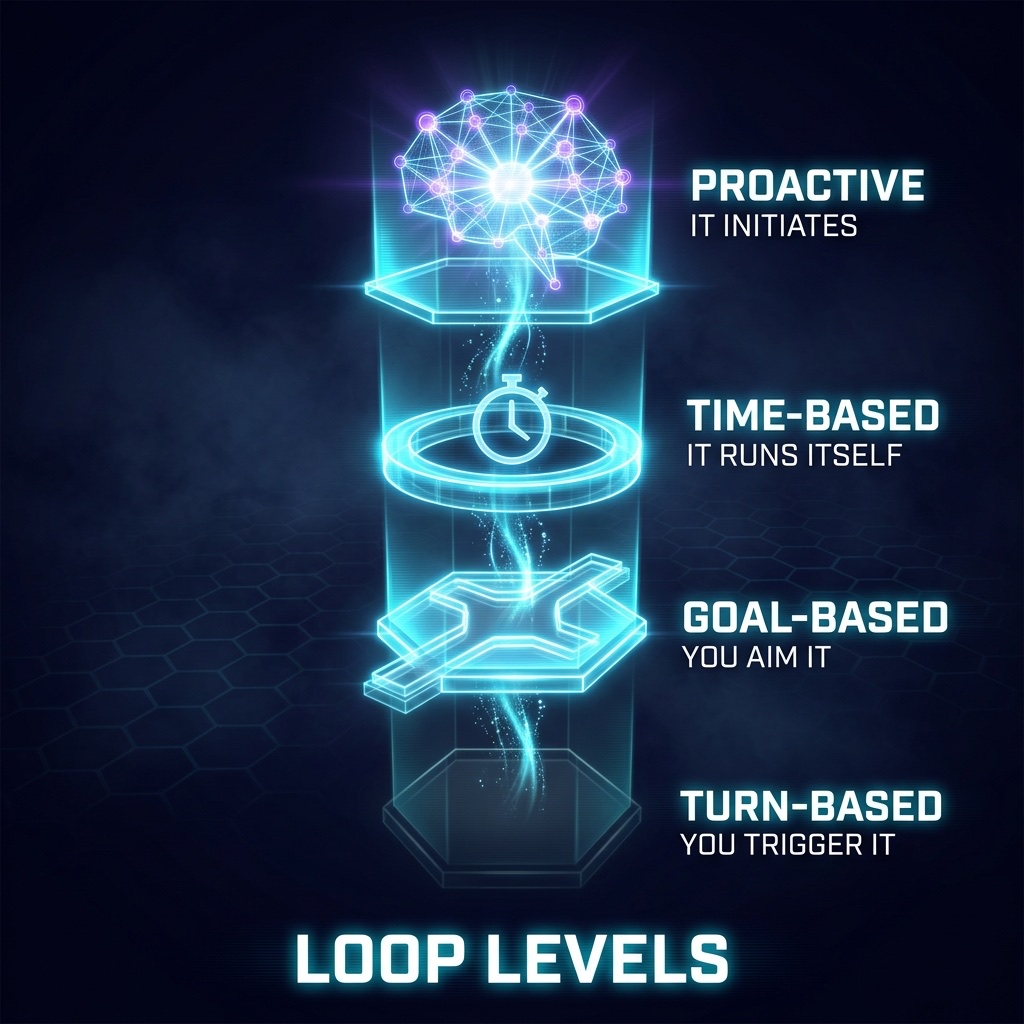
The Levels Stack
Each level includes the ones below it. A proactive agent still handles goals, runs on schedules, and responds to individual turns. The levels are not alternatives. They are layers.
Most teams are camped at Level 1, reaching occasionally into Level 2. The teams that will own the next decade are building infrastructure for Levels 3 and 4 right now.
Level 1: You use the agent. Level 2: You direct the agent. Level 3: The agent runs without you. Level 4: The agent initiates without you.
Every level up reduces your involvement in the trigger, increases the agent’s autonomy, and demands heavier trust architecture to support it.
Start where you are. If you are at Level 1, close a loop. If you are at Level 2, schedule something. If you are at Level 3, give the agent eyes on a live system and let it propose action when conditions change.
The loop is the unit of leverage. Engineer it.