


Mine Your Exhaust
Every agent session leaves behind a trail of friction, missing tools, and repeated corrections. Most people close the chat and move on, treating the session as a spent cartridge. But that trail is the single highest-signal source of rig improvements you will ever find, and ignoring it is like running a factory and throwing away the quality reports.

The Exhaust Is the Signal
When you operate an agent, two things happen at once. The agent does the work you asked for. And the session itself reveals every gap between your current rig and a better one.
The work output is obvious. You asked for a feature, a fix, a blog post, a data migration. That is the product. But the session also produced something else: a record of every point where the process was slower, dumber, or more brittle than it needed to be. That record is the exhaust.
Exhaust looks like:
- Repeated corrections. You typed the same steering instruction three sessions in a row. That instruction should be a rule file, not a memory you carry.
- Missing tools. The agent needed to hit an API, parse a format, or check a system it could not reach. You became the relay. That relay is a tool waiting to be built.
- Environment friction. A dependency was missing. A path was wrong. A credential had expired. The agent stalled and you fixed it by hand. That fix should be infrastructure, not heroics.
- Context gaps. The agent asked a question it should have already known the answer to. Your conventions, your preferences, your architecture decisions are not written down where the agent can see them. That is a context visibility problem.
- Pattern drift. The agent produced something that worked but did not match your standards. You caught it. You corrected it. But you did not codify the standard, so you will catch and correct it again tomorrow.
Every one of those is a rig upgrade disguised as a minor annoyance.
Most People Throw It Away
The default behavior is to treat agent sessions as fire-and-forget. Open a chat. Do the work. Close the chat. Start fresh next time.
This is the equivalent of running a production line and never reading the defect logs. The logs exist. They contain exactly the information you need to improve throughput, reduce rework, and eliminate failure modes. But nobody looks at them because the line is still producing output, and output feels like progress.
It is not progress. It is stasis with motion. You are doing the same work at the same speed with the same friction, session after session, while the information that would eliminate that friction scrolls off the screen.
The Operate Before You Automate principle says you should run a workflow yourself before you hand it to a machine. Mining your exhaust is the natural continuation of that principle. You operated it. You felt the friction. Now do something with what you felt.
What Mining Looks Like
Mining your exhaust is not a retrospective meeting. It is not a quarterly review. It is a habit that takes five minutes at the end of a session and pays compound interest forever.
After a session, ask three questions:
1. What did I repeat? Any instruction, correction, or context you provided more than once across recent sessions is a candidate for codification. Write it into a rule file that has teeth, a skill, or a system prompt. The correction you typed three times becomes a rule the agent reads every time. You never type it again.
2. What was I the relay for? Any moment where you became the bridge between the agent and a system is a missing tool. You copied data from one window and pasted it into the chat. You ran a command and reported the output. You checked a dashboard and described what you saw. Each of those is a closed loop waiting to happen. Build the tool. Give the agent direct access. Remove yourself from the signal path.
3. What broke that should not have? Environment issues, stale credentials, missing dependencies, broken paths. These are not one-time problems. They are recurring failure modes that will bite every future session until you fix them at the infrastructure level. Patch the workspace, not the session.
The Compound Effect
The reason this matters is not any single improvement. It is the compounding.
Session one: you fix a path issue and write a rule about code style. Session two: the path issue is gone and the agent follows the style guide without prompting. You notice a missing tool and build it. Session three: the tool is available, the style is right, and you finish in half the time. You notice a context gap and document a convention. Session four: faster again.
This is metaprogramming in practice. You are not just using the agent. You are using the agent to reveal what the agent needs, and then supplying it. The system improves itself through the act of being used.
Every session that ends without a rig improvement is a wasted data point. Not wasted work — the output was still delivered — but wasted signal. The exhaust told you exactly what to fix, and you let it dissipate.
The Five Exhaust Categories
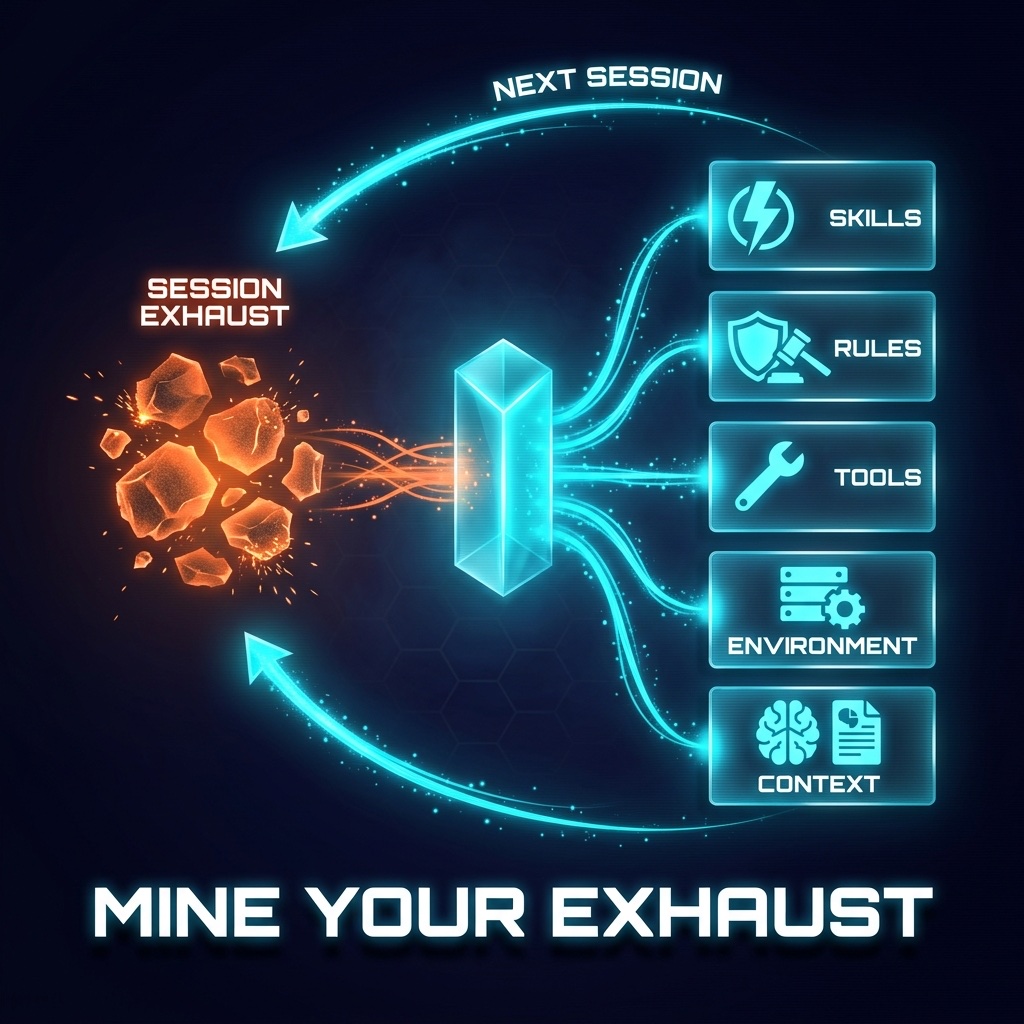
Not all exhaust is the same. Sorting it helps you prioritize.
Skills. Multi-step workflows the agent executes repeatedly. If you guided it through the same sequence more than twice, write a skill file. The skill encodes the sequence so the agent can replay it without your hand on the wheel.
Rules. Standards, preferences, constraints, conventions. If you corrected the agent’s output to match a standard it did not know about, write a rule. Rules are cheaper than corrections. One file prevents a thousand future edits.
Tools. Capabilities the agent lacks. If you were the API, the browser, the calculator, or the lookup service, build the tool. An MCP server, a CLI script, a shell function — the form does not matter. What matters is that the agent can reach the system directly next time.
Environment. Infrastructure the agent depends on. Missing packages, wrong versions, expired tokens, incorrect paths. These are not agent problems. They are workspace problems. Fix them once, permanently.
Context. Knowledge the agent should have but does not. Architecture decisions, naming conventions, deployment procedures, domain vocabulary. If the agent asked you a question whose answer should be ambient, write the answer into a doc the agent can read. Your prompt vocabulary improves when the agent already knows what you used to have to spell out.
The Operator Mindset
This is what separates someone who uses agents from someone who operates them. A user gets output. An Operator gets output and a rig upgrade. Same session, different extraction rate.
The Operator watches the run and thinks in two tracks simultaneously. Track one: is the work getting done? Track two: what is this run teaching me about the rig? Both tracks produce value. Most people only collect on track one.
This is the agentic version of sharpening the saw. You are not just cutting wood. You are using every cut to reveal where the blade is dull, and then sharpening before the next cut. The work and the improvement happen on the same timeline, fed by the same activity.
Mine It
Your agent sessions are already producing everything you need to build a better rig. The friction, the failures, the corrections, the relays, the environment snags — all of it is signal. All of it is ore.
Stop treating sessions as disposable.
Mine your exhaust.