


Every Great Agent Shares One Blueprint
A model, a prompt, and a few tools will get you a great demo. Turning that demo into an agent you trust with real work takes more parts, and they’re the same parts every time. There are 22 of them, grouped into eight layers, and every serious agent has some version of each. Once you can see the whole blueprint, you can build the agent you actually want, one deliberate choice at a time.

Agents look like magic until you see how they’re put together. Then the wish list turns into a parts list.
Want it to remember you? That’s Memory. Want it working while you sleep? That’s a Trigger. Want to trust it with production? Permissions and Hooks. Want it to keep getting better after launch? Evals.
Every capability you want from an agent is a part you can build.
The Blueprint
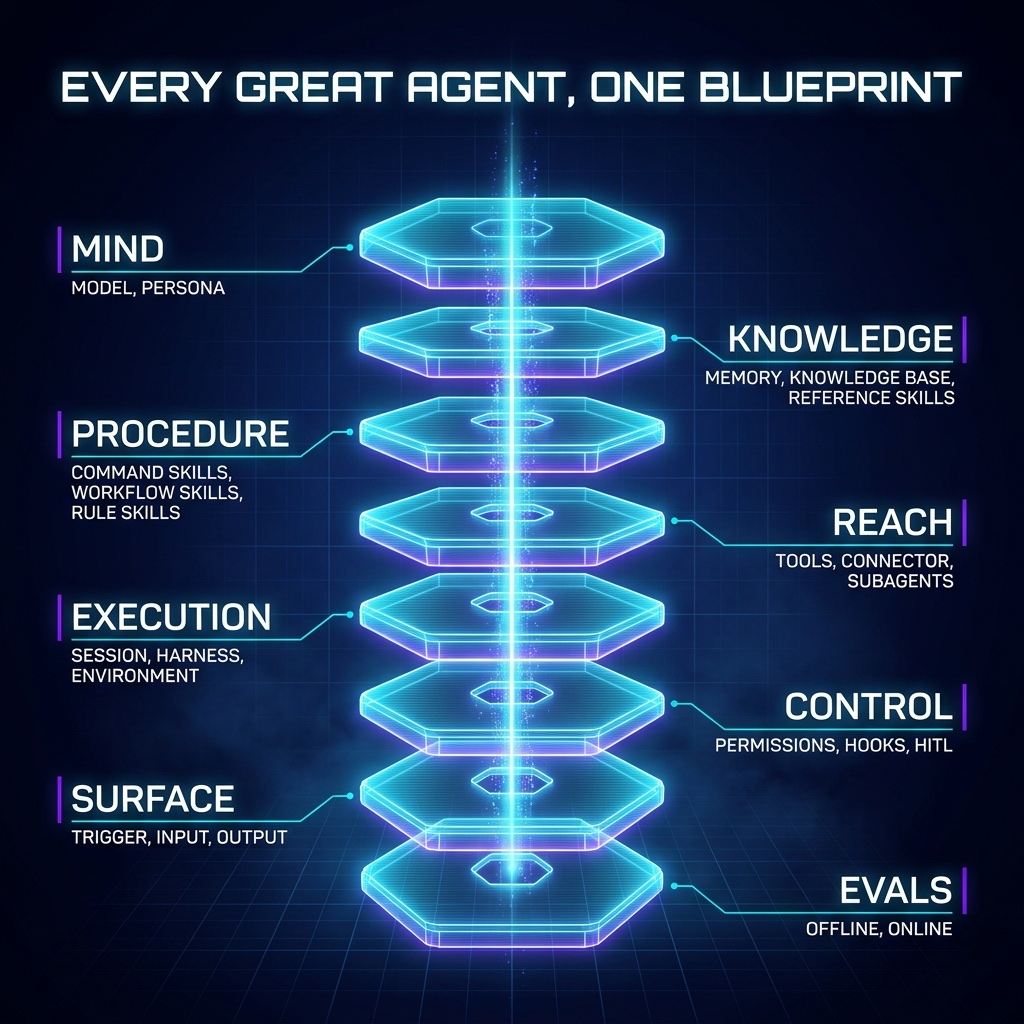
Eight layers, 22 parts. What you choose for each one is your agent’s design.
Mind
- Model - The intelligence, matched to the task’s cost and speed
- Persona - Who it is and how it acts when instructions run out
Knowledge
- Memory - What it carries forward from its own experience
- Knowledge Base - Curated material it can search
- Reference Skills - Compact expertise it pulls in when a task calls for it
Procedure
- Command Skills - Actions a person invokes by name
- Workflow Skills - Multi-step jobs that follow a set path
- Rule Skills - Standing guidance that applies without being asked
Reach
- Tools - Actions the model can call
- Connector - Authenticated links to outside systems
- Subagents - Work delegated to a separate context
Execution
- Session - One unit of work that can resume or fork
- Harness - Runs the loop, handles failures, stops when the budget is gone
- Execution Environment - Where the work physically happens
Control
- Permissions - What it can do without asking
- Hooks - What must happen no matter what the model wants
- HITL Primitive - How it stops and asks a person
Surface
- Trigger - What starts work when nobody is typing
- Input Interface - Where people hand it work
- Output Interface - The form finished work lands in
Evals
- Offline Evals - Proof a change helps before it ships
- Online Evals - Proof it’s still good in production
A small agent can settle some of these in one line. A personal assistant and a nightly code reviewer will choose very differently. The core loop stays the same, and the blueprint is everything you get to shape around it.
Chat Is the Wrong Noun
I used to call the Session part Chat. That name stops working the moment an agent does anything interesting.
Chat assumes a person typing and a reply coming back. A night shift run has no person. A subagent has no person. A webhook firing at 3am has no person. Nobody wanted a chatbot in the first place, and the word keeps dragging your design back toward one.
A Session is one bounded unit of work with its own context, whoever or whatever started it. Once you think in Sessions, Triggers and Subagents stop being special cases. They’re two more ways a Session begins, and your agent can suddenly do a lot more than reply.
Where the Lines Fall
The blueprint gets much easier to use once you can tell the similar parts apart.
Rule Skills and Hooks can both say “never push to master.” The rule asks. The hook blocks the push. Use a rule for judgment and a hook for anything you’d be furious to see violated, because deterministic shells control and models only try their best.
Permissions and the HITL Primitive work as a pair. Permissions decide when the agent has to ask. HITL is how it asks: an approve button, a multiple choice, a question in Slack. Get both right and you can give the agent far more room to run.
Memory has its own failure modes because the agent writes it. People curate a Knowledge Base, and the agent retrieves it in pieces. A Reference Skill is small, authored, and loaded whole. All three feed the context your agent’s IQ depends on, and they age at different speeds.
A Connector is the authenticated link, and the place to keep keys away from the model. Tools are what the model calls through it. One Connector can expose forty Tools.
Command and Workflow describe different things, too. Command is how a skill starts, Workflow is its shape, and a command can launch a workflow. Commands also double as your agent’s menu.
One Real Build
The agent workflow that produced this post makes a decent example.
/write-blog is a Command Skill. It launches a Workflow Skill with eight phases. The voice guide and the first-paragraph rule are Rule Skills. Two pauses for my review are the HITL Primitive. A scored AI-voice audit runs before anything reaches me, which makes it a simple Offline Eval.
The blueprint also shows where this build can grow. A Trigger could start a draft without me. Online Evals could report how each post performs after it publishes. And a Hook could enforce the link check that today lives in a Rule Skill, where broken links have still slipped through.
That’s the best part of having the whole map. You always know what to build next.
Pick the agent you want, then walk the eight layers and decide each part. The blueprint is the same for everyone. What you build from it is yours.