

Your Best Work Happens While You Sleep
Most operators treat their AI agents like day laborers: clock in, work together, clock out. The agents sit idle all night while the human sleeps, eight hours of the most expensive intelligence on the planet doing nothing. The fix is dead simple: every day before you leave your desk, kick off your biggest, most ambitious task on your heaviest model. Wake up to finished work. The night shift is free leverage.
Two Speeds, One Day
I run two different operating rhythms inside the same day.
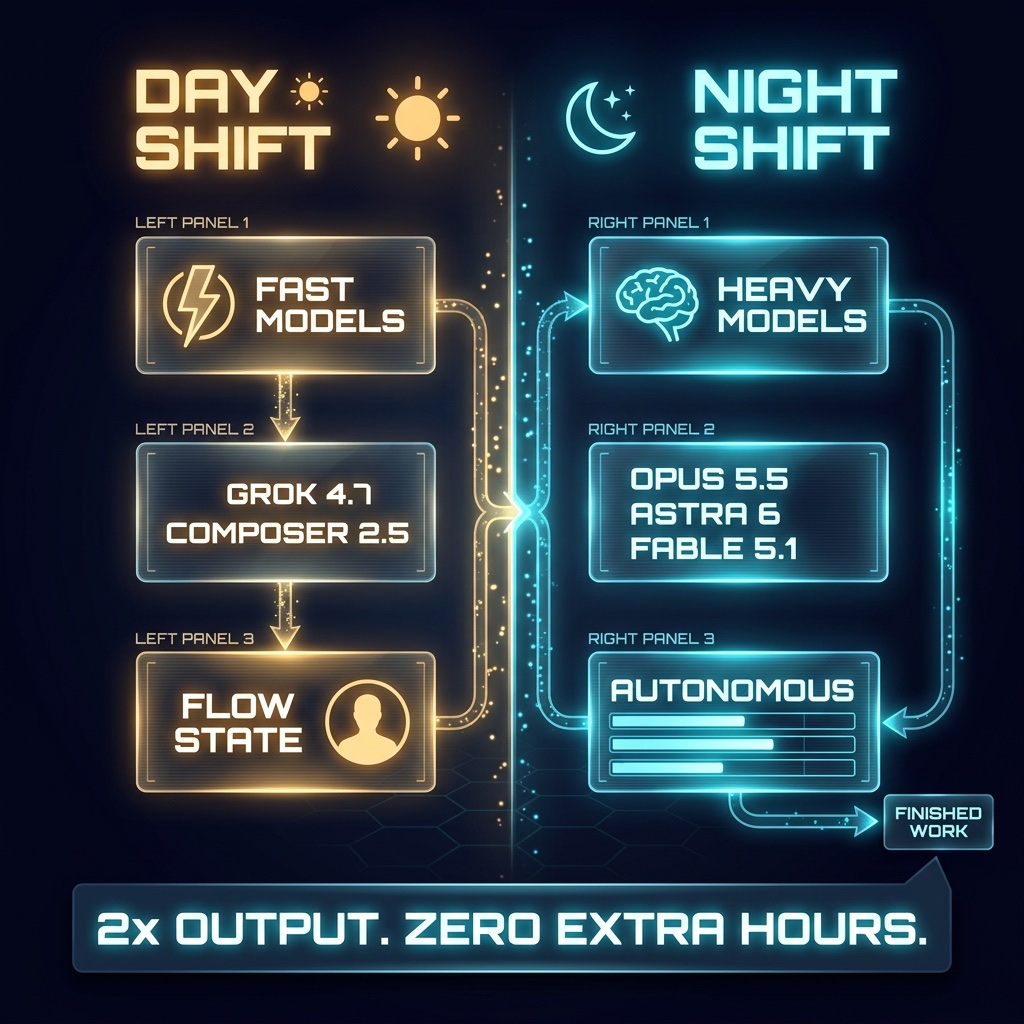
During the day, I stay in flow with fast models. Grok 4.7 and Composer 2.5. These are not the smartest models on the market. They are the fastest. They answer in under a second. They keep me in the zone. The day shift optimizes for velocity, short cycles, and zero wait time. I do not want to think about the model. I want to think about the work.
But the work I can finish in a day is bounded by my own attention. The tasks that take three, six, twelve hours of sustained agent effort do not fit inside a flow session. They interrupt. They demand monitoring. They turn me into the bottleneck. If I try to run a six-hour refactor alongside my day work, I end up splitting my focus across two half-finished jobs.
So I save the big work for the night shift.
The Night Shift
Every day before I leave my computer, I kick off at least one night shift project. Big. Ambitious. The kind of task that will tie up a high-intelligence agent for multiple hours.
The models I run overnight are different from my day crew. Claude Opus 5.5. GPT Astra 6. Fable 5.1. These are slow. They are expensive. And they are profoundly good at sustained, complex reasoning over long contexts. I would never run these interactively during the day because waiting 45 seconds per response kills flow. But at 11pm, when I am asleep, response latency is irrelevant. The only thing that matters is output quality when I wake up.
The night shift is not a scheduled cron job. It is a deliberate act of specification. I write the brief. I set the scope. I front-load the context so the agent has everything it needs to run for hours without asking me a single question. Then I hit Enter and close the laptop.
No back-and-forth. No “does this look right?” No incremental checkpoints. The agent has the full specification, the tools, and the authority to ship. I review the result in the morning.
What Goes on the Night Shift
Not everything belongs here. Night shift work meets three criteria.
First, the spec is writable. If I cannot describe what “done” looks like in a paragraph, the task is not ready. Night shift work needs a clear specification because there is no human in the loop to course-correct.
Second, the work is large. If it takes less than thirty minutes, I do it during the day with a fast model. Night shift tasks take two to eight hours of sustained agent effort. Big refactors. Full feature builds. Research sweeps. Test suite expansions.
Third, the result is verifiable. I need to judge the output in the morning without re-running the whole process. Tests pass. The build compiles. The document is coherent. The code diff makes sense. Proof of work replaces trust.
Examples from my own night shifts: a complete API migration across 40 endpoints. A new blog post researched, drafted, and illustrated. A full competitive analysis across six products. A test harness that exercises every public method in a library. A refactor of an entire module from callbacks to async/await with full test coverage.
Each of these would have eaten my entire day if I ran them interactively. Instead they ran while I slept, and I reviewed the output over coffee.
The Economics
A fast day model like Grok 4.7 costs pennies per query and returns in under a second. You burn maybe a few dollars across an entire workday. The value is in your flow, your attention, your human throughput.
A heavy night model like Opus 5.5 or Astra 6 might cost $15 to $50 for a multi-hour agentic run. That sounds expensive until you realize the alternative was spending your own day on it. If you value your working hours at anything north of $100/hour, a $30 overnight agent run that produces six hours of skilled labor is the best trade in your budget.
The fast models protect your attention. The heavy models multiply your output. Same person. Double the working hours. Zero additional fatigue.
The Discipline
The concept sounds simple. The hard part is the discipline of preparation.
You cannot kick off a night shift with a vague prompt and hope for the best. That produces a vague result and a wasted night. Specification is the bottleneck, and front-loading it is the price of admission.
My end-of-day ritual takes 15 to 30 minutes:
- Pick the biggest task on my board that has a writable spec.
- Write the spec. Constraints, examples, edge cases, definition of done.
- Load the context. Files, docs, references, everything the agent will need.
- Choose the right heavy model for the task type.
- Launch. Close the laptop.
This is building the workspace, not building the artifact. The 20-minute investment at end-of-day buys a full night of machine intelligence working at its ceiling.
Level 3 for Free
If you know the loop engineering levels, Level 3 is time-based: agents that run on a schedule without a human trigger. The night shift is a manual version of Level 3. You trigger it once, at the end of the day, and the agent runs autonomously through the night.
Most people stall at Level 1 (turn-based) and never touch Level 3 because the infrastructure feels heavy. The night shift sidesteps that. No scheduler. No persistent state. No orchestration framework. Just one deliberate launch per day, timed to the moment your attention is no longer available.
This also solves the dark factory problem at personal scale. Your agents work the line at 3am. You are the Operator who reviews the output at 7am. No elaborate infrastructure required. Just the discipline to prepare the work and let it run.
The Compounding Effect
One night shift per day is five extra machine-days per week. Five runs that each produce work you would have spent a full day on. Over a month, that is twenty extra days of high-intelligence output. Over a year, it is 250.
You are not working harder. You are not working longer. You are loading the heaviest intelligence you have access to with the biggest task you can specify, at the exact moment your own brain checks out.
Your best agents should work the night shift. Every night. Starting tonight.