

Nobody Ever Wanted a Chatbot
Nobody in the history of human communication has wanted to “just chat.” Every conversation ever started was reaching for something beyond the words: a relationship, an insight that changes your trajectory, an action taken on your behalf, an impact on the world. The billion-dollar AI industry built chatbots anyway. MIT found that 95% of enterprise AI pilots deliver zero return. The reason is not technical. Chatbots answer a question nobody asked.

Chat Is the Medium, Not the Goal
When you call a friend, you are not seeking words. You are seeking connection: the feeling of being known, the comfort of someone who has your back. When you sit across from a doctor, you are not seeking conversation. You are seeking a diagnosis and a treatment plan. When you talk to your financial advisor, you are not paying for pleasant exchange. You are paying for a decision that shapes the next ten years.
Chat has never been the point. Chat is a carrier wave. The signal riding it is always something else: trust, knowledge, action, relief, progress.
Companies watched the transformer revolution and thought: the model can talk. Let us make it talk to customers. They wrapped a language model in a text box, wrote a system prompt, and called it a product.
And 95% of those projects failed.
The Numbers Tell a Story We Already Knew
MIT’s Project NANDA found that 95% of enterprise generative AI pilots show no measurable return to the income statement (August 2025). RAND Corporation puts the broader AI project failure rate above 80%, roughly twice the rate of non-AI IT projects. S&P Global reported that 42% of businesses scrapped most of their AI initiatives in 2025, up from 17% the year before.
The standard diagnosis: poor data foundations, unclear success metrics, weak integration into business workflows.
That diagnosis is right but shallow.
The deeper failure is a product failure. These companies built the wrong thing. They built conversational interfaces and shipped them as if conversation were the product. But a chatbot just says: “How can I help you?” And the user thinks: “I don’t know. You tell me.”
That gap is where 95% of the money went to die. The chatbot puts the entire burden of specification on the user. It has no context about the business. It has no tools to act. It has no memory of what happened yesterday. It is a language model wearing a customer service costume.
What People Actually Want
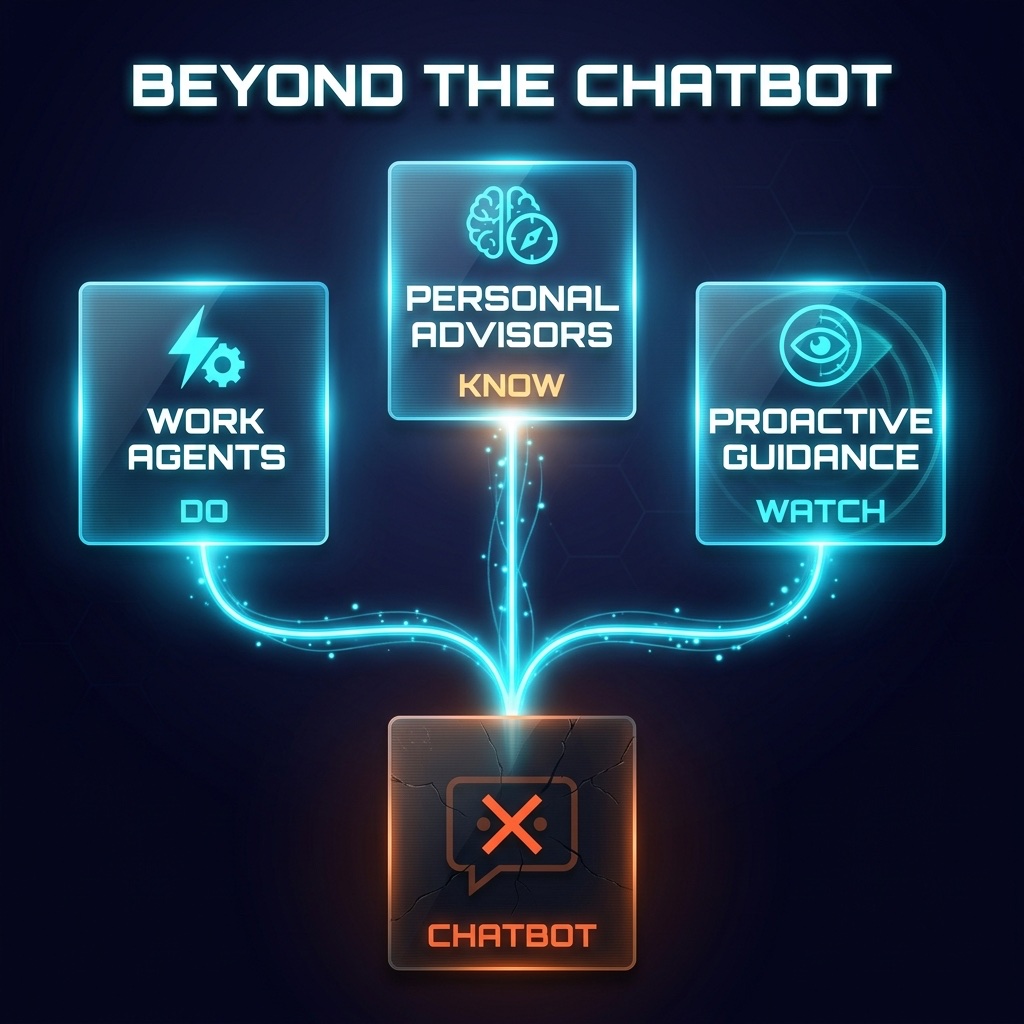
Strip the interface away and ask what the human was after. Three patterns show up every time.
Work Agents
The user does not want to describe a task and then verify the description was understood. The user wants the task done.
Not talked about. Done.
A work agent has tools, permissions, context, and the authority to execute. It ships the code, files the report, routes the approval, updates the system of record, and returns proof. This is the gap between a chatbot and an agentic shell. A chatbot talks about capabilities. An agentic shell exercises them.
When everything is one message away from done, you have stopped chatting. You are commanding.
Personal Advisors
Some interactions are not about tasks. They are about judgment.
A user wants an advisor who knows their situation, their history, their goals, their constraints, and who returns a specific recommendation with reasoning attached. Not generic wisdom. Not “have you considered…” hedging. A named call with evidence behind it.
A chatbot gives you search results in paragraph form. A personal advisor tells you what to do and why, given everything it knows about you. The difference is context depth. A chatbot has your last three messages. An advisor has your financial history, your health trajectory, your stated goals, your revealed preferences. An agent’s IQ matches its context, and a chatbot with no context is a smart model acting dumb.
Proactive Ambient Guidance
The most valuable form is the one you never initiate.
No chat window. No conversation. A system that monitors conditions, recognizes when something needs attention, and surfaces the right insight at the right moment, before you know to ask.
Your agent notices a production latency spike and starts investigating. It detects churn risk in three enterprise accounts and alerts the account owner with evidence. It spots a scheduling conflict forming next week and resolves it quietly.
This is what proactive loop engineering makes possible. A chatbot sits at level one, turn-based, waiting for your question. Proactive ambient guidance operates at level four, monitoring the environment and initiating action without a human trigger.
The agent workspace that supports this needs connected data, scoped permissions, closed verification loops, and a clear escalation path. The infrastructure is serious. But the payoff is a system that works while you sleep.
The Chatbot Was a Detour
The chatbot was the first thing we knew how to build, not the thing anyone needed.
The model could talk, so we let it talk. That was a demo, not a product. A real product starts with what the user wants, and nobody wants to chat with software. People want software that works, advises, and watches so they can spend their attention on things that actually require a human.
The 95% failure rate is not a mystery. It is the market clearing its throat.
AI natives will not use your web app. They will not use your chatbot either. They will use agents that carry context, exercise real authority, and deliver results without requiring a conversation.
Stop building chatbots. Build agents that do work, advisors that know you, and systems that act before you ask.