


AI Natives Stop Asking How
Every new AI user starts with the same questions. Can it do this? How do I get it to do this? How do I explain what I want? Those are Old Days questions, left over from a world where the person with the idea had to wrangle every tool and every handoff before anything got made. The people getting the most out of AI have quietly stopped asking them, and they now spend their words on what the world should look like when the work is done.

The Genie Is Out
AI is a genie. Say it clearly and it shows up. A financial model. A working app by Friday.
For most of history that was fantasy, so we built whole careers around the gap between saying and getting. Old Days work was mostly figuring out how, checking whether it was even possible, and explaining it to the people who would do it. Kickoffs, tickets, handoff docs, status meetings. The person with the idea spent maybe a tenth of their week on the idea.
I wrote that the 6,000-year era of human execution just ended. That post was about companies. This one is about people, and what happens to a person who keeps working with agents for a year.
Natives Climb Toward Purpose
Watch someone become AI native and you see the same climb every time.
Early on, they ask the genie for help with the how. “Write me a SQL query.” “Fix this formula.” They still do the job. AI is a faster pair of hands.
A few months in, they ask for whole pieces. “Build the dashboard.” “Draft the email sequence.” They still think in units of work they used to do themselves.
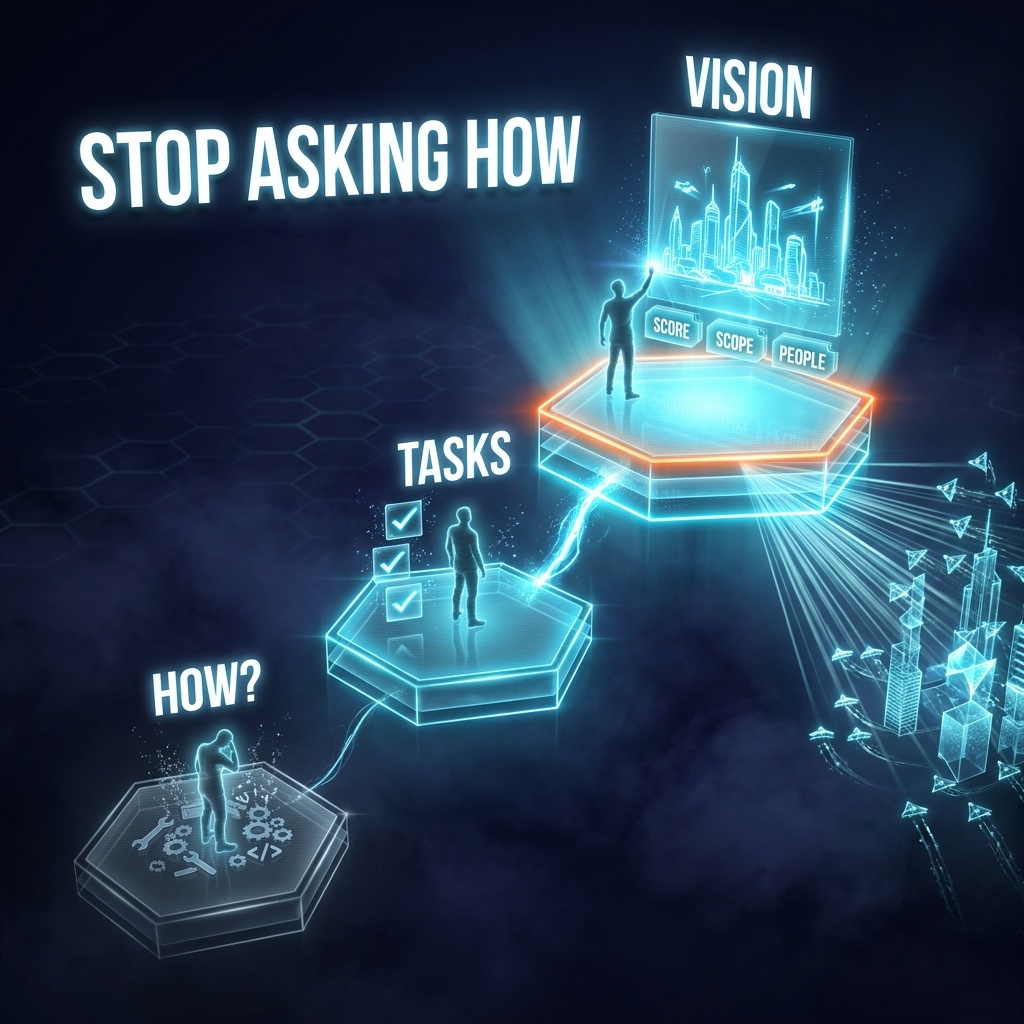
Then something flips. They stop describing work and start describing the world. “Every account over $50K should have a renewal plan two quarters before it expires, and I want to see the ones that don’t.” Nobody mentioned a query, a dashboard, or a reminder. The agents sort that out.
Each step moves the person further from mechanism and closer to purpose.
The how shrinks. The why grows.
What a Visionary Declares
A visionary hands the agent a picture of the finished world and a way to score it. No procedure.
That picture is made of words and images. A sketch on a whiteboard, a screenshot of a competitor that gets it almost right, a voice memo from the car. Images carry more intent per second than any paragraph, and every agent worth using can read them now.
Then comes the score. What number says done? Conversion rate, days to close, minutes to first value. If you don’t name the score, the agent picks one for you, and it will pick the easiest one to hit. I score my prompts like a scientist for exactly this reason.
Then scope. How big should the change be? One landing page or the whole funnel? Agents will happily do either, so you have to say which. Where does it apply, and with whom? Which market and which customers? Who signs off, and who just needs to hear about it?
I’ve argued that specification is the bottleneck. This is what specification looks like at the top of the climb. Every sentence is about outcome. None of them are about mechanism.
Three Jobs, Before and After
The Marketer
Old Days: a campaign starts with a brief, then a kickoff, then a media plan in spreadsheets, then trafficking across ad platforms, then a reporting dashboard analytics gets to eventually. At the agency Jellyfish, campaign setup used to take weeks, and a partner there said clients sometimes waited up to 40 days for a dashboard.
New Era: Jellyfish now runs AI agents for media buying across Google, Meta, and Amazon. The agents set up campaigns, organize the data, and shift budgets daily. Launch time dropped 65%, and dashboards show up the same day (Adweek).
So what is left for the marketer? Declaring this:
“400 qualified demos from mid-market logistics companies in Q1, under $300 each. Lead with the cost-of-delay story. This hero image is the mood. Leave the enterprise budget alone. Anything that mentions pricing goes to sales leadership first.”
That’s the whole input. Everything after it is execution.
The Financial Analyst
Old Days: a banker wants to pitch a deal. The analyst pulls comps from Capital IQ, keys them into Excel, builds the model, pastes the numbers into a pitchbook, formats forty slides, and writes the cover email. A week of late nights. The question the banker actually cared about, whether this deal makes sense for this client, gets an hour on Thursday.
New Era: in May 2026 Anthropic shipped finance agent templates, including a pitch builder. You hand it a target list. It hands back a comps model in Excel, a draft pitchbook, and a cover note, and a human approves it before it goes anywhere.
The analyst who thrives now writes:
“Our client wants to be a top-three cold-chain player in the Southeast within three years. Show which of these twelve targets gets them there with the least dilution. Rank them on EBITDA margin and customer overlap. Board meets Thursday.”
Same analyst. Their week moved from formatting slides to forming a view.
The Software Engineer
My own field went first. Old Days: pick up a ticket, read the code, choose an approach, write it, test it, open a PR, wait for review, fix comments, merge. Every question was a how. Which library? Which pattern?
Coding agents write the code now. The engineers I see pulling ahead write things like:
“A new customer should get from signup to their first completed workflow in under ten minutes. Today it’s forty. Here’s a screen recording of where people get stuck. Ship it to 10% of new signups, watch completion rate, then roll it out.”
Then they review the product instead of the diff. If completion rate moved, it shipped. If it didn’t, they close the loop and say what the world should look like next.
The Trap Is the How
People who were great at the how cling to it. It was their identity. The senior engineer knew every framework. The senior analyst was the fastest person in Excel on the whole floor.
Every hour spent proving you still know the how is an hour you didn’t spend deciding what should exist. The genie runs on intent, stated clearly enough to act on. You get the AI you ask for, and the people who ask for the most are the ones who stopped asking how.
Say what the world ought to be. Show a picture. Name the score, the size, the place, and the people. Then let the agents build it while you sleep, and wake up ready to look at what changed.
Stop asking how. Become a visionary. Shape the world.