


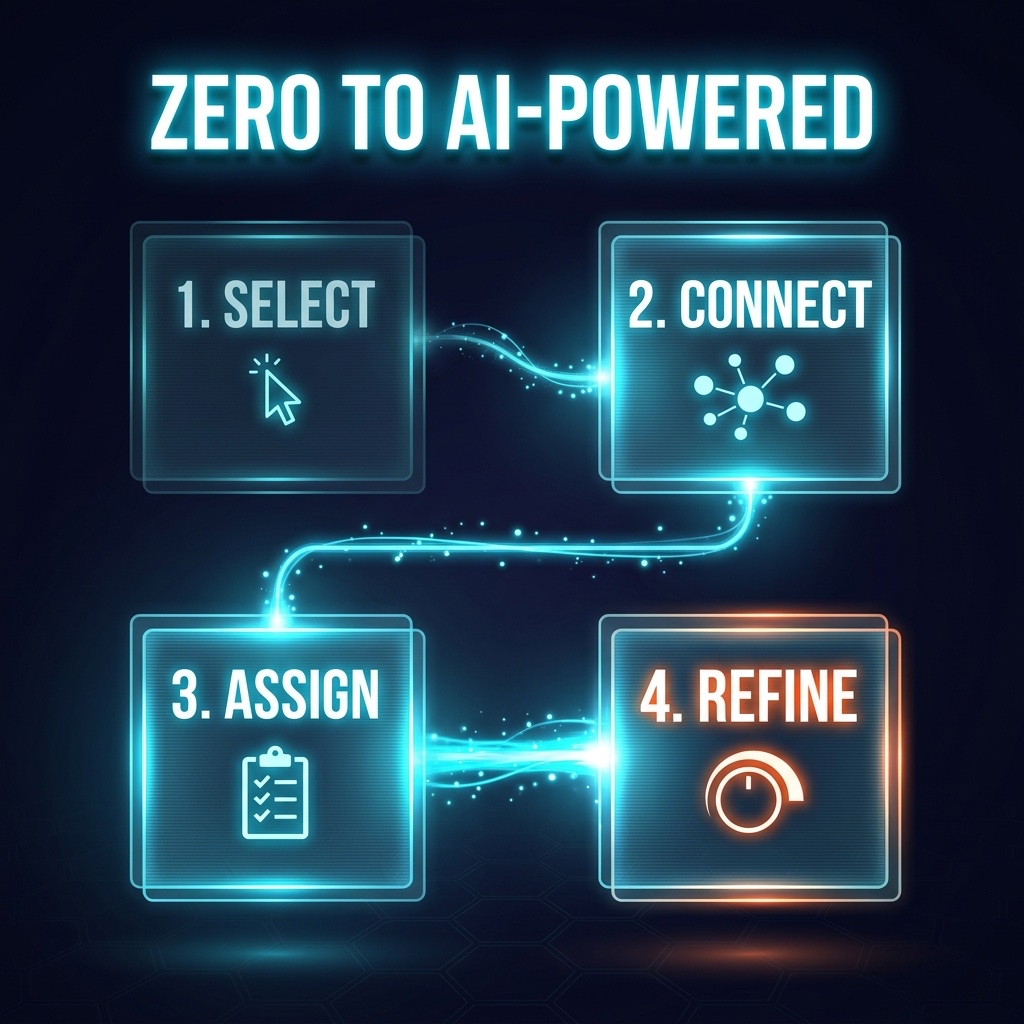
Four Steps from Zero to AI-Powered
Most businesses are using AI. Very few have AI working for them. The typical setup is a ChatGPT or Claude subscription that somebody on the team pokes at when they need a draft or a summary. That is the starting line, not the finish line. Going from manual prompting to AI that delivers real results on its own takes four steps.

The Gap Between Using and Operating
Nine out of ten organizations use AI in at least one function. But ask what “use” looks like and the picture deflates. Somebody pastes a document into a chat window, asks for a summary, copies the output into Slack. Somebody else asks Claude to rewrite an email. That is AI as a slightly faster coworker you have to babysit every time.
The businesses pulling real value have crossed a line most haven’t. They stopped typing into a chat box and started connecting AI to their actual systems, giving it real jobs, and refining the output until it runs without hand-holding. The distance between “I use AI” and “AI works for me” is a maturity gap, and it is exactly four steps wide.
Step 1: Select
You probably already have a subscription somewhere. Maybe two. Maybe your team has three different tools and nobody agreed on one. Fix that. Pick one AI provider. One. Consolidate. One subscription, one login, one place your team works.
If you have no strong opinion, pick OpenAI or Anthropic. Both have desktop apps, business plans, and the ability to connect to outside tools. The model matters less than the commitment. Bouncing between ChatGPT, Claude, Gemini, and Copilot means none of them have enough context to be useful. One small action changes everything.
Commit. Move on.
Step 2: Connect
Install the desktop app. Then start connecting your actual work systems, one at a time.
Gmail. Google Calendar. Slack. QuickBooks. Jira. Notion. Salesforce. Blender. Unity. Whatever you and your team actually touch every day.
Every tool you connect gives your agent more context. Context is everything. An agent that can see your calendar, your inbox, and your project board is an order of magnitude more useful than one that can only answer generic questions in a chat window.
Start read-only. Let the agent observe before you let it act. You will be surprised how much value comes from an agent that can simply look across all your systems and answer questions.
Step 3: Assign
This is where most people stall. They have the subscription. They connected some tools. Then they open the chat and type… “help me be more productive?”
No. Assign the agent a real job. Spell out the deliverable, the cadence, and the format.
Bad assignment: “Help me with my business.”
Good assignment: “Every Monday morning, pull last week’s revenue from QuickBooks and the top 10 support tickets from Zendesk. Summarize the revenue trend and the three most urgent customer issues. Post the summary to #leadership in Slack by 8am.”
That is a job description, not a wish. You get the AI you ask for. Vague asks produce vague results. Specific deliverables produce specific output.
Step 4: Refine
Your agent will not nail it on the first try. Expect 70% right. Maybe 60%.
Review the first few deliverables. Tell the agent what to fix. “The revenue summary is too long. Shorten it to three bullet points.” “You missed the comparison to the same week last year.” “Stop including tickets that are already resolved.”
Welcome to calibration. Every correction you give tightens the loop. Within a few cycles, the agent produces exactly what you need, when you need it, in the format you want.
The mistake is expecting perfection on day one and abandoning the whole thing when it falls short. The people who win with AI are the ones who own the operator role: review, correct, and iterate until the output is dialed in.
The Whole Playbook
Select. Connect. Assign. Refine.
That is the entire path from zero to AI working for your business. Not a transformation. Not a strategy deck. Four concrete actions, each one building on the last.
The first two you can finish in an afternoon. The third takes real thought about what you actually want the agent to do. The fourth takes a few cycles of honest feedback.
A month from now, you will either have an AI agent producing real deliverables for your business every week, or you will still be bookmarking demos. The difference is not talent. The difference is whether you start.
Select. Connect. Assign. Refine.
Start today.