


Pick a Lane: Factory or Frontier
A year ago I wrote that AI workers fall into four tiers (Conscript, Cyborg, Centaur, Centurion), stacked from least output per human to most. The tiers are still real. The implied ladder isn’t. The longer I work alongside agents and watch the people who do it well, the clearer it gets that there isn’t one destination at the top of the stack. Two lanes are opening up in front of every serious operator, and they reward completely different instincts. Pick the wrong one and you’ll either over-systemize a problem nobody has solved yet, or you’ll keep hand-crafting work the world has already turned into a commodity. Both mistakes are expensive. Only one is recoverable.
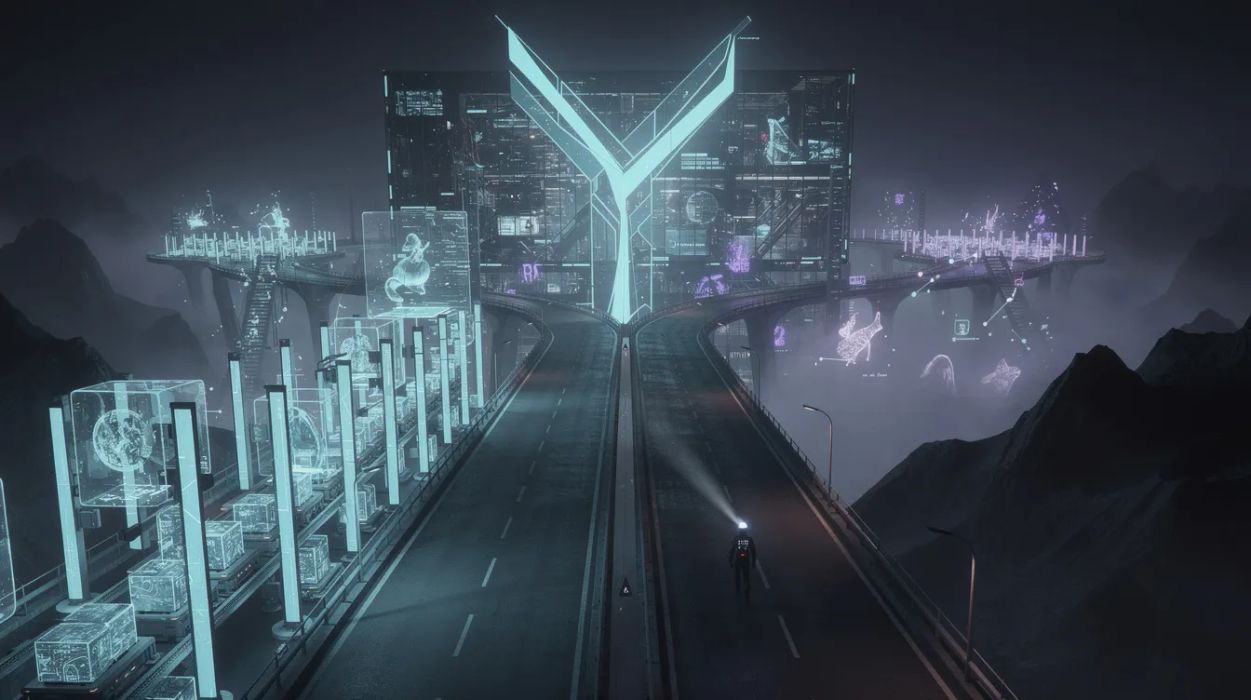
What I Got Right, and What I Missed
The original post said there’s a tier above Cyborg called Centurion: the operator running a hundred agents like a small company. That’s still true. People are doing it. Some of them are getting absurdly rich.
What I implied, and shouldn’t have, is that Centurion is the destination and Cyborg is a stop on the way there. As if every fluent human-AI hybrid should eventually graduate into running a fleet, and anyone who didn’t was simply less mature.
That’s wrong. Centurion is a different job from Cyborg, not a higher rung. (I’m using Cyborg in the sense Ethan Mollick mapped out in Centaurs and Cyborgs on the Jagged Frontier: human and AI braided into one continuous flow, instead of a clean handoff.)
The thing that finally cracked it for me is a much simpler observation:
AI is extraordinary at solved problems with known solutions. AI is mediocre at genuine innovation, taste, and frontier work.
That single asymmetry forks the entire career map.
Two Lanes, Not One Ladder
Two kinds of work exist in the world right now, and AI changes them in opposite directions.
Lane One: Solved Work. Patterns the world already knows. SOPs. CRUD. Reconciliation. Tier-1 support. Standard contracts. Standard refactors. Standard onboarding. Standard backoffice. Most of the actual labor inside every company is here. It’s been documented, blogged, fine-tuned, and embedded a thousand times over. AI eats this lane alive.
Lane Two: Frontier Work. Things nobody has done yet, or things that only work because of taste and context that doesn’t exist in any training corpus. New product categories. Novel architectures. Original research. New companies. New game mechanics. New aesthetic directions. AI helps here, but only as a tool inside the hands of someone with a frontier instinct.
These two lanes need different humans, different tooling, and different rituals. A Centurion’s stack is built for throughput on solved patterns. A Cyborg’s stack is built for speed of discovery in the dark. They look similar on the surface (both run agents, both use IDEs full of inference, both burn tokens like fuel) but the org charts, the eval loops, and the success metrics aren’t the same animal.
Centurions industrialize the solved. Cyborgs scout the unsolved.
The Centurion Lane: Industrialize the Known
If your work has a known shape, if there’s a playbook, a checklist, a regulatory pattern, a textbook process, your job is to turn that shape into a factory.
This is the Centurion lane, and it really is the new managerial superpower. The work looks like:
- Codify the SOP into specs an agent can execute.
- Build the eval harness that proves the agent is doing it right.
- Wire the queues, the retries, the escalation rules, and operate before you automate.
- Define budgets, kill switches, observability.
- Hire Operators to babysit the line.
- Compound on the same factory until it’s a moat.
The reward is enormous. One Architect plus a handful of Operators plus a hundred agents plus a tight feedback loop equals the output of a fifty-person team. That’s the dark factory I’ve been writing about. That’s the line Lovable can’t sell you, because you have to build exactly what you want. That’s the lane where systemization is the whole game.
But you can only run this lane on work that is genuinely solved. If the problem is novel, if the spec keeps mutating, if the eval can’t be written because nobody knows what “right” looks like yet, if every artifact has to be judged by a human with taste, your factory will produce a hundred confidently-wrong artifacts per hour and you’ll burn cash discovering you were never in this lane.
The Cyborg Lane: Scout the Unknown
The other lane is the one I underrated.
A Cyborg isn’t a worse Centurion. A Cyborg is the human-AI hybrid who is making things that didn’t exist yesterday. Building a new kind of agent. Designing a game mechanic. Writing original research. Prototyping a product in a category that doesn’t have a category yet. Running experiments where the next move is determined by what the last experiment surprised you with.
This is frontier work, and it has a different shape:
- The spec is wrong until you build the prototype.
- The eval can’t be written; the only judge is your own taste.
- Most outputs get thrown away, and that’s the point.
- The flow is human and AI moving through the same fog at the same speed, trading the wheel sentence by sentence.
- You don’t run a hundred agents on this; you run two or three, very tightly, as extensions of yourself.
This is also a real career. It is, in many ways, a more durable career, because frontier work is the one thing AI can’t autonomously produce. AI averages. Frontier work is the opposite of averaging. It’s the deliberate refusal to accept the median answer. That refusal is a uniquely human signal, and the people who can wield it (with AI as a force multiplier rather than a replacement) are going to print value for the next decade.
A Cyborg’s job is to find, not to scale. Once they find, they hand the artifact off to a Centurion, sometimes themselves wearing a different hat, to industrialize.
The Two-Lane Map
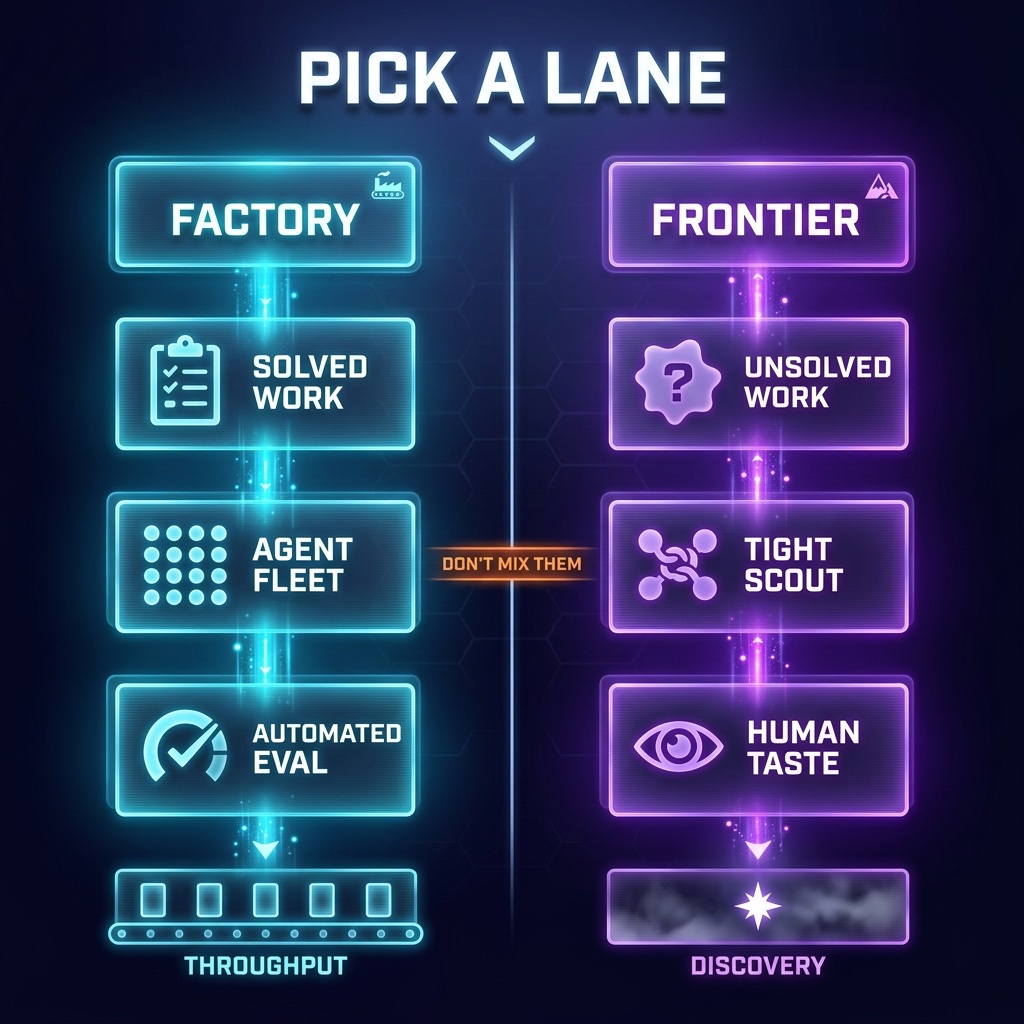
Both lanes use agents. Both lanes burn tokens. A great Cyborg may run a dozen agent tools in a single afternoon, and a great Centurion is almost always personally a strong Cyborg too. The tooling overlaps. The intent doesn’t.
| Factory Lane (Centurion) | Frontier Lane (Cyborg) | |
|---|---|---|
| Type of work | Solved patterns, known SOPs | Novel, unsolved, taste-driven |
| Goal | Throughput and margin | Discovery and originality |
| Spec | Written, versioned, evaluated | Emergent, mutable, sometimes private |
| Eval | Automated, measurable, ruthless | Human taste, slow, qualitative |
| Agents | 50-500, parallel, queued | 2-5, tight, intertwined |
| Failure mode | Process gaps, drift, silent errors | Premature systemization, lost magic |
| Career identity | Architect / Operator | Builder / Researcher |
The Two Expensive Mistakes
Picking a lane requires brutal honesty about the problem, not the practitioner. Both lanes have a characteristic failure that costs founders, teams, and individual careers serious money.
Mistake one: the Cyborg who should have systemized. They keep hand-crafting the same workflow for the fortieth time because it feels artisanal. They love the flow state. They tell themselves the work is too judgment-heavy to automate. Meanwhile a competitor in the Factory lane has turned the same workflow into a $3-an-execution agent fleet and is eating their lunch while they polish their pottery. Most “irreducible judgment” is actually unwillingness to write the eval.
Mistake two: the Centurion who should have scouted. They take a problem that looks like it has a known shape (drug discovery, novel UX, original strategy, brand voice, anything genuinely creative) and pour it into a factory. The factory dutifully outputs a hundred mediocre, on-pattern artifacts per day. They confuse volume for value. They burn a runway industrializing a solution that the world hadn’t actually figured out yet, and they ship the median when the whole point was to ship the exceptional. Most “obvious automation” is actually a problem nobody has solved well in the first place.
The honest question, before you build the line or burn another week iterating manually, is this:
Is this problem actually solved? Or am I telling myself a story about that?
If solved, industrialize. Hire Operators. Compound. Stop typing.
If unsolved, stop pretending. Pull the agents in close. Trust your taste. Run small. Run weird. Throw most of it away. Find the thing.
Same Tools, Different Souls
The cleanest way I can put it: Cyborgs and Centurions both run agents, but they’re not running them for the same reason.
A Cyborg runs agents to extend their nervous system into the unknown. A Centurion runs agents to extract their nervous system from the known.
Both are real, lucrative careers. Neither is the upgrade path of the other. The original post made it sound like a ladder. It is, in fact, a fork.
Pick the lane that fits the problem in front of you. Not the one that flatters your self-image. Reassess the lane every quarter. Switch when the problem switches. The people who get richest in the agent era won’t be the ones who picked Centurion or Cyborg the loudest. They’ll be the ones who, every single time a new piece of work landed on their desk, asked the boring question first: factory or frontier?
And then actually answered it honestly.